Quick Answer
A pool alkalinity calculator guide helps estimate how much alkalinity-adjusting chemical may be needed based on your pool volume, current alkalinity, target level, and product strength. Instead of guessing the amount, you can use your actual water reading and pool size to get a more practical estimate. Always compare the result with the product label before making an adjustment.
What Is Pool Alkalinity?
Total alkalinity measures the water’s ability to resist changes in pH. It acts as a buffer that helps keep pH more stable during normal pool use and chemical treatment.
When alkalinity is too low, pH can become unstable and may change quickly. When alkalinity is too high, pH can become difficult to lower and other water-balance problems may develop.
This pool alkalinity calculator guide makes the dosage calculation easier by using the information from your actual pool instead of relying on a fixed amount for every swimming pool.
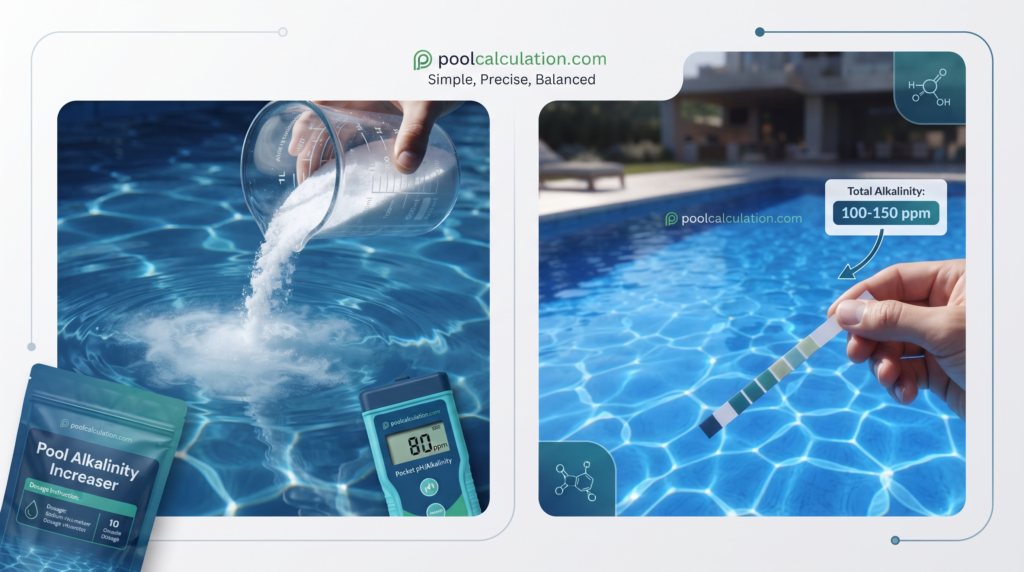
For many residential pools, a commonly used total alkalinity range is around 80 to 120 ppm. The ideal target can vary depending on the pool type, sanitizer, surface, and overall water-management method.
How Does The Pool Alkalinity Calculator Guide Work?
The calculation generally depends on three important factors:
- Current total alkalinity
- Desired alkalinity level
- Pool water volume
The chemical being used also matters because different products have different concentrations.
For example, if your pool has an alkalinity reading of 60 ppm and your target is 100 ppm, you need to increase alkalinity by 40 ppm. The pool volume then determines how much chemical is required to produce that increase.
This is why the same amount should not be used for every pool. A 5,000-gallon pool and a 20,000-gallon pool will require different amounts to achieve the same alkalinity increase.
Information You Need Before Calculating
| Input | Why It Matters |
| Pool volume | Determines how much water needs treatment |
| Current alkalinity | Shows the starting level |
| Target alkalinity | Determines the required adjustment |
| Chemical product | Identifies the product being used |
| Product strength | Affects the required amount |
Accurate measurements are important. An incorrect pool volume or water reading can make the calculated dosage inaccurate.
How to Use the Calculator
Using pool alkalinity calculator guide is straightforward when you have the correct information.
Step 1: Determine Pool Volume
Find the actual water capacity of your pool. If the pool has multiple depths or an unusual shape, use the most accurate volume available.
Step 2: Test Total Alkalinity in Pool Alkalinity Calculator Guide
Use a suitable pool test kit to measure the current alkalinity. Record the result before adding any adjustment chemicals.
Step 3: Choose Your Target
Determine the alkalinity level you want to reach based on your pool’s recommended range.
Step 4: Enter the Information
Add the pool volume, current alkalinity, target level, and product information to the calculator.
Step 5: Review the Result
The calculator will provide an estimated amount of chemical required. Check the measurement unit carefully before measuring the product.
Step 6: Compare With the Product Label
The calculated amount should always be compared with the manufacturer’s recommended dosage and application instructions.
Raising Low Pool Alkalinity Calculator Guide
Low alkalinity can cause unstable pH and make water chemistry more difficult to manage.
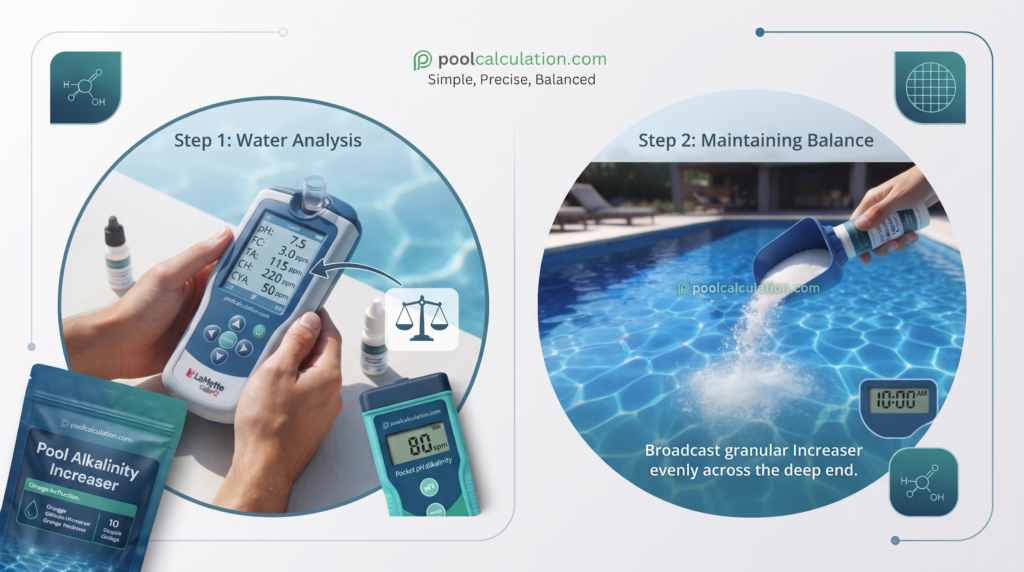
If your test shows that alkalinity is below the desired range, use an appropriate alkalinity-increasing product according to its instructions.
The general process is:
- Test the current alkalinity.
- Determine the desired increase.
- Calculate the estimated chemical amount.
- Add the product according to its label.
- Allow the water to circulate.
- Retest the alkalinity.
Avoid adding a large amount at once. Gradual adjustments make it easier to reach the desired range without pushing alkalinity too high.
Lowering High Pool Alkalinity
High alkalinity can make pH difficult to lower and may contribute to scaling or cloudy water in certain conditions.
If your alkalinity is too high, correction usually requires careful chemical adjustment followed by circulation and retesting.
Do not repeatedly add acid without checking the water. Lowering alkalinity can also affect pH, so both readings should be monitored during the process.
A pool alkalinity calculator guide can help estimate the amount required, but the actual treatment should always account for the product instructions and current water chemistry.
Pool Alkalinity and pH
Pool Alkalinity Calculator guide and pH guide are closely related, but they are not the same measurement.
| Measurement | Main Purpose |
| pH | Shows how acidic or alkaline the water is |
| Total alkalinity | Helps resist changes in pH |
| Both together | Provide a clearer picture of water balance |
If your pH constantly rises or falls after adjustment, checking alkalinity can help identify whether the underlying problem is related to water buffering.
A pool chemistry guide should therefore explain both measurements rather than treating them as interchangeable.
Common Alkalinity Problems
| Problem | Possible Effect | What to Check |
| Low alkalinity | Unstable pH | Total alkalinity |
| High alkalinity | pH difficult to lower | Alkalinity and pH |
| Repeated pH changes | Poor buffering | Complete water balance |
| Incorrect dosage | Chemistry moves too far | Pool volume and product strength |
If alkalinity repeatedly moves out of range, look for the reason instead of repeatedly adding correction chemicals.
Common Calculation Mistakes
Even a calculator cannot produce a reliable result from incorrect information. Avoid these mistakes:
- Guessing pool volume
- Using an old test result
- Confusing pH with alkalinity
- Selecting the wrong product
- Ignoring product concentration
- Making large adjustments at once
- Failing to circulate before retesting
- Assuming another pool’s dosage will work for yours
The goal is to make a measured adjustment and then verify the result with another water test.
Frequently Asked Questions
What is the ideal pool alkalinity?
A commonly used range for many residential pools is around 80 to 120 ppm, although the appropriate target can vary depending on the pool and its overall chemistry.
What happens when alkalinity is too low?
Low alkalinity can make pH unstable and cause frequent fluctuations that are difficult to control.
What happens when alkalinity is too high?
High alkalinity can make pH harder to lower and may contribute to scaling or cloudy water under certain conditions.
Should I test pH and alkalinity together?
Yes. Testing both gives you a better understanding of the pool’s overall water balance.
Can I calculate alkalinity adjustment without knowing pool volume?
You need an accurate pool volume to estimate the appropriate chemical amount. Without it, the calculation can be significantly off.
Conclusion
This pool alkalinity calculator guide provides a practical way to estimate the chemical amount needed to adjust total alkalinity according to your pool volume and water readings. It removes much of the guesswork involved in deciding how much product to use.
For better results, determine your pool volume accurately, test alkalinity before making changes, choose the correct target, follow the product label, and retest after circulation. Making gradual adjustments helps keep alkalinity and pH more stable while reducing unnecessary chemical use.