
Quick Answer
A pool shock calculator helps estimate how much shock your pool may need based on pool volume, current chlorine, target chlorine, and the strength of the product you plan to use. It gives you a more measured starting point than simply adding a fixed number of bags. Always compare the result with the product label and retest the water after treatment.
Pool Shock Calculator
Pool Shock Calculator
Calculate the exact amount of liquid chlorine, cal hypo, dichlor, or another shock product needed to reach your selected free chlorine level.
Enter your pool volume, current chlorine reading, target treatment level, and shock product information to get an estimated dosage. The result is intended as a practical calculation, while the manufacturer’s instructions should always take priority.
Current Pool Shock Calculator pages commonly use pool gallons, current free chlorine, target free chlorine, and product strength as their core inputs. Some also consider CYA or the reason for shocking when establishing the treatment target.
How to Calculate Your Shock Dose
The basic idea behind a pool shock calculator is to determine how much the free chlorine level needs to increase and then convert that increase into the amount of your selected product.
First, determine the difference between your target and current chlorine:
Required increase = Target chlorine − Current chlorine
For example, if your pool has 2 ppm free chlorine and your selected target is 10 ppm, the required increase is 8 ppm.
The pool volume then determines how much available chlorine is needed to produce that increase. Finally, the strength of the selected shock product converts the chlorine requirement into pounds, ounces, or fluid ounces.
This is why a fixed “one bag per pool” rule is unreliable. The same treatment does not apply equally to a 5,000-gallon and a 20,000-gallon pool. Competitive calculator pages use the same volume-and-chlorine-gap approach, while more advanced tools also account for CYA.
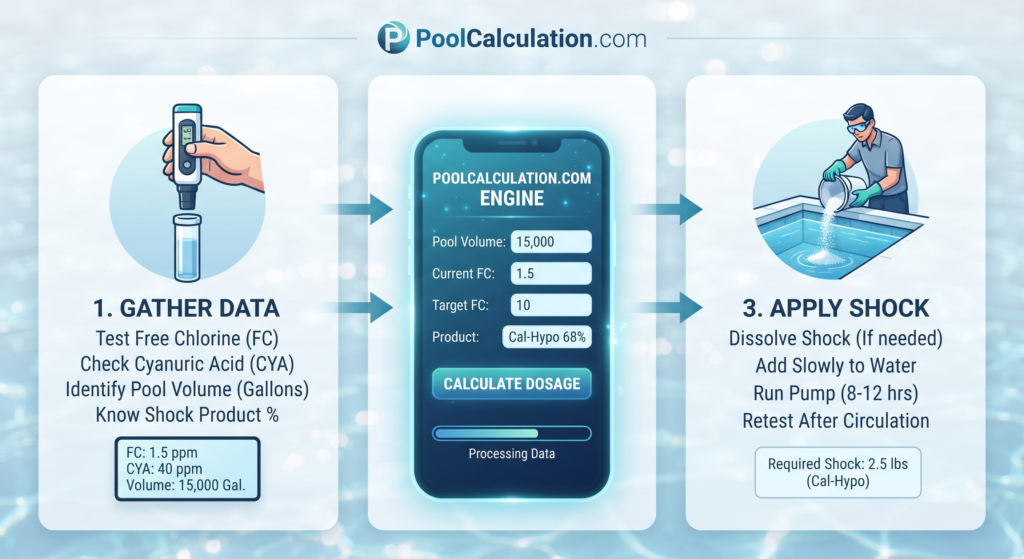
Information You Need Regarding Pool Shock Calculator
| Input | What It Tells the Calculator |
| Pool volume | How much water must be treated |
| Current free chlorine | Your starting chlorine level |
| Target chlorine | The level you want to reach |
| Shock strength | How concentrated the product is |
| CYA or treatment purpose | May affect the appropriate shock target |
Understanding Your Result
After entering the information, the pool shock calculator returns an estimated amount of product.
Check the unit carefully. Granular shock is commonly measured by weight, while liquid chlorine is usually measured by volume. Different products are also not interchangeable simply because they weigh the same. A 56%, 68%, or 73% product contains different amounts of available chlorine.
If your result is displayed in pounds but the product is sold in one-pound bags, you can use the result to understand how many bags you need to have available. However, do not automatically round upward and add extra product without checking the label.
The calculated amount is an estimate based on the information entered. Your actual treatment should also account for the product instructions and fresh water-test results.
Pool Shock Dosage Chart
A pool chemical dosage chart can be useful for quickly understanding how the required amount changes with pool size. The table below regarding Pool Shock Calculator is a general comparison rather than a universal product dose.
| Pool Size | Relative Shock Requirement |
| 5,000 gallons | Lower |
| 10,000 gallons | Moderate |
| 15,000 gallons | Higher |
| 20,000 gallons | Higher |
| 30,000 gallons | Significantly higher |
The exact amount depends on the chlorine increase and product concentration. For example, current competitor charts provide separate doses for different product strengths and treatment levels rather than treating all shock as identical.
When Should You Use Pool Shock Calculator?
The purpose of shocking matters because not every water problem requires the same chlorine treatment.
Green or Algae-Affected Water
Green water often points to algae growth and increased chlorine demand. If you’re searching for green pool how much shock, don’t choose the amount based only on how green the water looks.
Check the pool volume, chlorine reading, CYA where relevant, and product strength. Algae treatment may also require brushing, filtration, circulation, and continued testing.
Cloudy Water
Cloudy water can result from several issues, including inadequate sanitation, poor filtration, contaminants, or unbalanced water chemistry.
Shock may be useful when chlorine demand is contributing to the problem, but it should not automatically be treated as the solution to every cloudy pool.
Heavy Pool Use
A large number of swimmers can increase chlorine demand. Testing after heavy use can help determine whether a stronger treatment is appropriate.
How to Use the Calculator
For a more reliable result, follow this process to use Pool Shock Calculator:
- Confirm your pool volume. Use the actual water capacity if available.
- Test the water. Record the current free chlorine level.
- Check CYA if required. Some shock methods use CYA when determining the target.
- Identify your shock product. Check its available chlorine percentage.
- Enter the information. Use the correct units.
- Review the result. Check whether the output is in pounds, ounces, or fluid ounces.
- Compare it with the label. The manufacturer’s dosage instructions take priority.
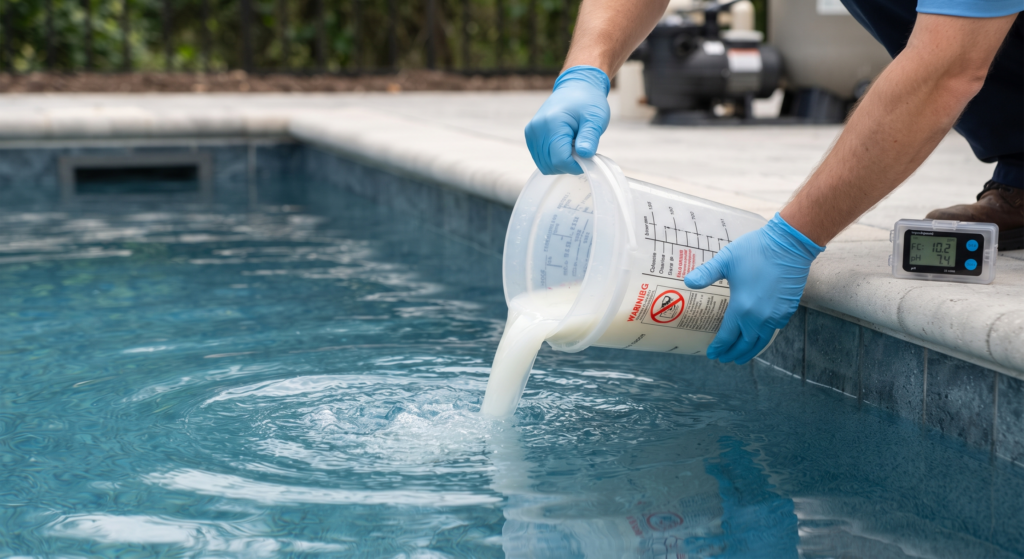
- Apply the treatment correctly. Follow the product’s application instructions.
- Circulate and retest. Use the new reading before deciding whether another dose is necessary.
Current calculator guidance similarly recommends testing first, confirming pool volume and product strength, then retesting after circulation rather than repeatedly applying the same dose.
Common Mistakes to Avoid
The accuracy of your result regarding pool shock calculator depends heavily on the information you enter. Avoid:
- Guessing the pool volume
- Using an old chlorine reading
- Selecting the wrong product concentration
- Confusing pounds with bags
- Assuming every shock product has the same strength
- Ignoring CYA when the chosen method requires it
- Adding another dose before the first treatment has circulated
- Using a general chart as an exact product instruction
The pool shock calculator should support your water-testing process, not replace it.
Pool Shock Safety
Read the product label completely before using shock. Store chemicals in their original containers and keep them away from children and pets.
Never mix pool chemicals together unless the manufacturer specifically states that they are compatible. Follow the recommended application method and any instructions regarding circulation and swimming.
After treatment, retest the water before swimming. Calculator results are estimates and should not override product-specific safety directions.
Frequently Asked Questions
How much shock does my pool need?
It depends on your pool volume, current chlorine, target level, and product strength. Enter those measurements into the calculator and verify the result against the product label.
Can shock clear a green pool?
It can be part of algae treatment, but green water may also require filtration, circulation, brushing, and ongoing water testing.
Should I test before shocking?
Yes. Testing tells you the current chlorine level and helps determine whether additional treatment is actually needed.
Conclusion
A pool shock calculator gives pool owners a practical way to estimate shock dosage using pool volume, current chlorine, target treatment level, and product strength. Unlike a fixed bag-per-pool rule, this approach adjusts the calculation to the actual conditions of the pool and chemical being used.