Quick Answer
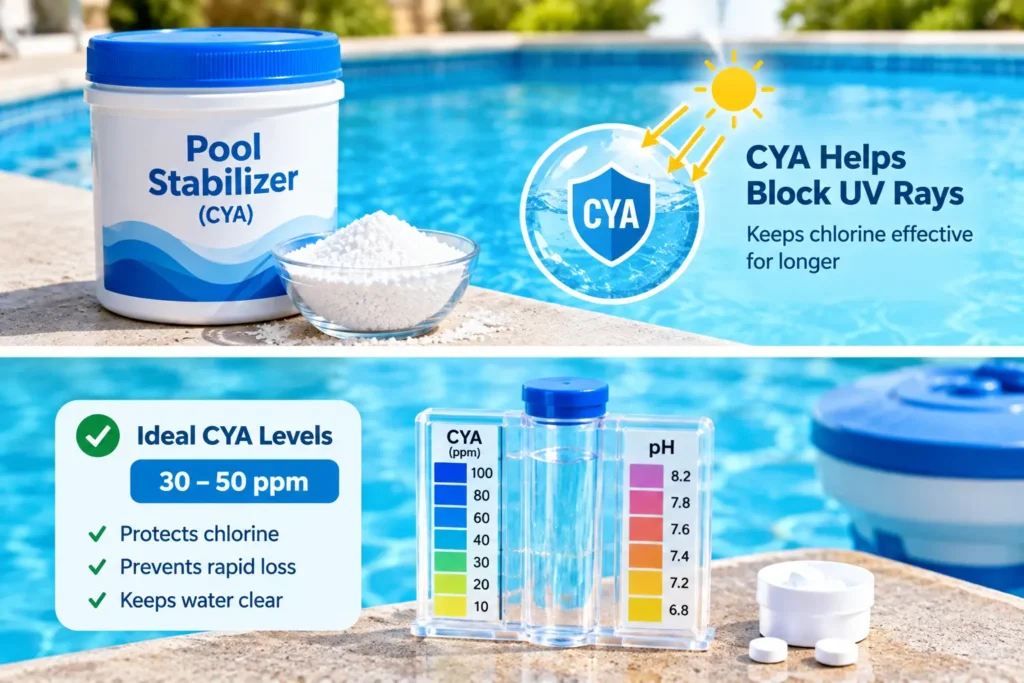
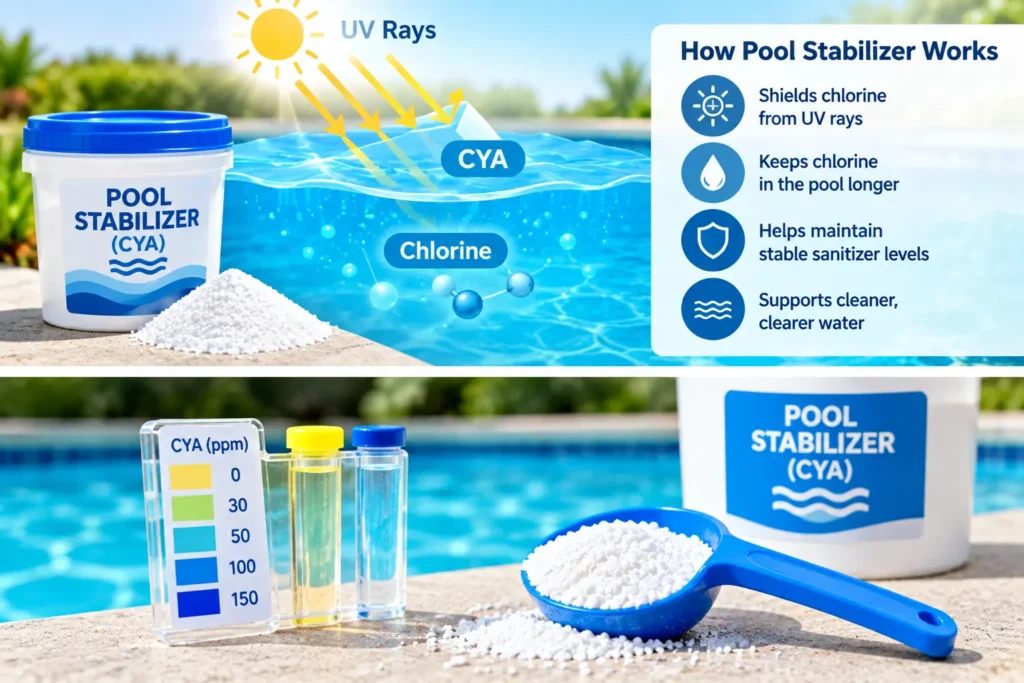
What is pool stabilizer? Pool stabilizer is cyanuric acid, commonly called CYA. It helps protect chlorine from being broken down too quickly by sunlight. Maintaining an appropriate CYA level can help a chlorine based pool keep its sanitizer working effectively.
What Is Pool Stabilizer Used For?
What is pool stabilizer mainly used for? Its primary job is to reduce the rate at which sunlight destroys free chlorine. Without enough CYA in an outdoor pool, chlorine can be consumed quickly by UV exposure, which may make it harder to maintain a consistent sanitizer level.
This does not mean adding more stabilizer is always better. CYA stays in the water, so adding too much can create a different water management problem. The goal is to test the water, understand the current level, and add only what is appropriate for the pool.
For pool owners comparing products, a dedicated [pool stabilizer product page] can be useful when choosing a product that matches the pool’s needs.
How Cyanuric Acid Works With Chlorine
Cyanuric acid acts as a buffer that helps protect chlorine from sunlight. When CYA is present at an appropriate level, chlorine can remain available in the water for longer than it would in an unstabilized outdoor pool.
This relationship is important because chlorine is still the sanitizer doing the disinfection work. CYA does not replace chlorine, and adding stabilizer should not be treated as a substitute for regular water testing.
A useful way to think about it is:
- Chlorine provides sanitation.
- CYA helps protect chlorine from sunlight.
- Testing shows whether the balance is appropriate.
- Proper dosing prevents unnecessary buildup.
What CYA Level Should a Pool Have?
Knowing what is pool stabilizer is useful when reading a CYA test result and deciding whether a product is actually needed.
The correct CYA level depends on the pool type, sanitizer system, climate, and the recommendations for the specific chemicals being used. Always follow the product label and pool equipment guidance rather than relying on a single number for every situation.
If a test shows that the level is low, a pool owner may need to add stabilizer. If the level is already high, adding more is not the solution.
For example, a pool owner who is seeing chlorine disappear quickly in strong sunlight may first test both chlorine and CYA rather than automatically adding another chemical.
Signs Your Pool May Need Stabilizer
Understanding what is pool stabilizer also means knowing when it may be relevant. A low CYA reading can be one possible reason an outdoor pool struggles to maintain chlorine, although other factors can also affect chlorine demand.
You may want to test CYA and learn about what is pool stabilizer and also when to test:
- The pool has recently been filled or partially drained.
- A large amount of fresh water has been added.
- Chlorine levels fall unusually quickly.
- You are starting a new pool care routine.
- Your sanitizer system or chemical program has changed.
Testing is especially important before adding a product. Guessing can lead to unnecessary chemical use and make the water harder to manage.
How to Add Pool Stabilizer
Knowing about what is pool stabilizer , Before adding stabilizer, test the existing CYA level and determine the pool’s water volume as accurately as possible. The amount required depends on those measurements and the product concentration.
Follow the manufacturer’s directions for preparation, dosage, and application. Some products dissolve differently from others, so do not assume that every stabilizer should be added in exactly the same way.
A practical process is:
- Test the current CYA level.
- Confirm the pool volume.
- Calculate the amount needed according to the product instructions.
- Add the product as directed.
- Allow adequate circulation.
- Retest according to the product guidance.
Avoid adding another dose simply because the test result does not change immediately. Some stabilizer products take time to dissolve and become fully measurable.
What If Cyanuric Acid Is Too Low?
Low CYA can allow sunlight to reduce chlorine more quickly in an outdoor pool. If testing confirms that the level is below the recommended range for your pool and chemical system, stabilizer may be needed.
The best approach is controlled adjustment rather than adding a large amount at once. Use the pool volume and current test result to determine the appropriate amount, then retest after the product has had time to circulate and register accurately.
If you are researching cyanuric acid pool care, remember that CYA is only one part of water chemistry. Chlorine, pH, alkalinity, and other readings also matter.
What If CYA Is Too High?
High CYA is different from low CYA because simply adding another chemical does not solve the problem. Since stabilizer can remain in the water, repeated additions may cause the concentration to build over time.
If testing shows a high reading, review your recent chemical additions and water replacement history. Depending on the situation, partial water replacement may be one method used to reduce the concentration. Follow local pool care guidance and product instructions before taking action.
A pool owner should avoid trying to correct high CYA by guessing at chemical doses. Accurate testing is the better starting point.
Stabilizer and Your Pool Product Routine
If you are asking what is pool stabilizer because you are comparing products, start with the current CYA reading rather than choosing a dose based only on pool size.
A product supporting approach to pool care starts with matching the product to an actual water care need. If your testing shows that CYA needs adjustment, choose a stabilizer product with clear dosing instructions and use it according to the label.
Before purchasing, check the product concentration, recommended application method, and compatibility with your pool care system. Keeping the product information and your latest test results together can also make future maintenance easier.
For ongoing cya acid management, it is useful to record CYA readings alongside chlorine and other important water measurements.
Common Stabilizer Mistakes
Avoid these common problems:
- Adding stabilizer without testing first.
- Treating CYA as a replacement for chlorine.
- Adding repeated doses before the previous dose has had time to register.
- Ignoring the actual pool volume.
- Continuing to add stabilizer when the CYA level is already high.
- Assuming every product has the same dosage instructions.
Small, measured adjustments are generally easier to manage than large corrections.
Final Takeaway
What is pool stabilizer? It is cyanuric acid, a pool chemical used to help protect chlorine from sunlight in outdoor pools. The key is not simply adding stabilizer, but keeping the level appropriate for your pool and sanitizer system.
Test before dosing, follow the product label, and give the chemical enough time to circulate before judging the result. When CYA is managed as part of a complete water care routine, chlorine can be better protected from sunlight and pool maintenance can become more predictable.
If your test shows that you need to adjust CYA, review the [pool stabilizer product page] for the product’s specific directions and dosage information before adding it to your pool.