Quick Answer
What does baking soda do for a pool? Baking soda, also known as sodium bicarbonate, is commonly used to raise total alkalinity in pool water. It can help stabilize pH and reduce sudden changes in water chemistry. The correct amount depends on pool volume, current alkalinity, and the target level. Test the water before adding it, follow product instructions, and retest after circulation. Exploring all about what does baking soda do for a pool, we will know well about each bit of it.
Introduction
Understanding what does baking soda do for a pool helps pool owners maintain balanced water without making unnecessary chemical adjustments. Baking soda is primarily used to increase total alkalinity, which helps buffer the water against rapid pH changes.
It is important to know that baking soda does not work like every other pool chemical. It mainly affects alkalinity and may also cause a smaller change in pH. Before purchasing a product, test your pool water and identify whether alkalinity actually needs adjustment.
If you are looking for a suitable product, explore the [Pool Alkalinity Products product page] to compare available options and select one that matches your pool maintenance needs.
What Does Baking Soda Do for a Pool?
The main purpose of baking soda in pool water is to increase total alkalinity. Total alkalinity helps resist sudden pH changes, making it an important part of routine water balancing.
When alkalinity is too low, pH may fluctuate more easily. This can make it harder to maintain comfortable water conditions and may contribute to corrosion or other water-balance problems.
Baking soda can help increase alkalinity gradually when used in an appropriate amount. However, adding it without testing can push alkalinity too high, which may make pH management more difficult.
How Baking Soda Affects pH and Alkalinity
Total alkalinity and pH are connected, but they measure different things.
- Total alkalinity measures the water’s ability to resist changes in pH.
- pH indicates how acidic or basic the water is.
- Baking soda primarily raises total alkalinity and may raise pH modestly.
If pH is low but alkalinity is already within the recommended range, baking soda may not be the right product to correct the issue. The appropriate treatment depends on both test results and the product’s instructions.
How Much Baking Soda Does a Pool Need?
The amount required depends on the pool’s water volume and the difference between the current and desired alkalinity. There is no single dose that works for every pool.
For example, imagine a 10,000-gallon pool with a total alkalinity reading of 60 ppm. If the pool’s maintenance target is 80 ppm, the required increase is 20 ppm. The exact amount of baking soda should be calculated using the product’s dosage directions and verified against a fresh water test.
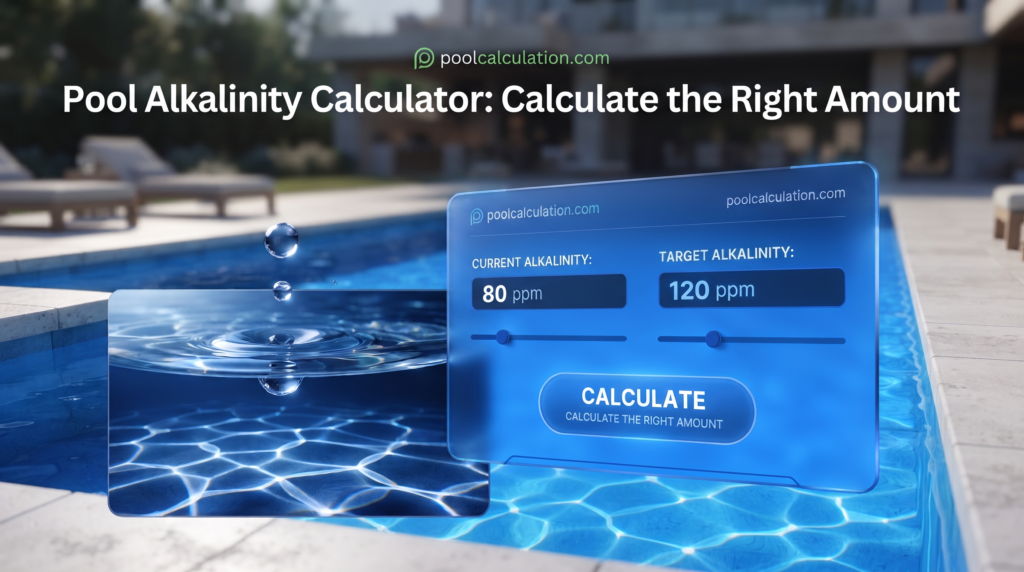
A pool alkalinity calculator can help estimate the starting quantity based on pool volume and current readings. Treat the result as an estimate rather than a guarantee, because testing accuracy, water volume, and product concentration can affect the result.
Avoid adding a large amount all at once. A staged adjustment makes it easier to prevent overshooting the target.
How to Add Baking Soda to Pool Water
When you have confirmed that alkalinity is low, follow a careful process:
- Test the water: Measure total alkalinity and pH using a suitable pool test kit.
- Confirm pool volume: Use an accurate estimate of the actual water volume.
- Calculate the dose: Check the product label or use a suitable calculator to estimate the required amount.
- Read product instructions: Follow the directions for handling and adding the specific product.
- Add gradually: Apply the measured quantity as directed, avoiding concentrated piles in one spot.
- Circulate the water: Run the pump as recommended to help distribute the product.
- Retest: Allow sufficient mixing time, then check alkalinity and pH before making another adjustment.
Always wear any protective equipment specified on the label, and store pool chemicals securely away from children and pets.
Can You Mix Baking Soda With Other Pool Chemicals?
Pool chemicals should not be mixed together directly unless the product labels explicitly permit it. Even when two products are commonly used in pool maintenance, combining them in a container or concentrated solution can create unwanted reactions or handling risks.
If you are wondering can you mix baking soda and bleach, do not combine them in a bucket, bottle, or other container. Use each product separately, according to its label, and allow proper water circulation between treatments as directed by the manufacturers.
Never mix chlorine products with acids, and always follow the safety directions for each chemical.
Signs Your Pool May Need Baking Soda
Testing is the reliable way to determine whether alkalinity needs correction. Some water-balance issues may include:
- Total alkalinity below the recommended range
- pH that changes frequently despite routine care
- Difficulty maintaining stable water chemistry
- Test results showing that alkalinity needs to be raised
Cloudy water or swimmer discomfort alone does not prove that alkalinity is low. Check the complete water chemistry before choosing a treatment.
Common Baking Soda Mistakes
Using too much baking soda can raise alkalinity beyond the desired range. This may make pH harder to manage and can contribute to scaling under some water conditions.
Other common mistakes include guessing the pool volume, relying on an old test result, adding chemicals without reading the label, and retesting before the water has mixed adequately.
Remember that what does baking soda do for a pool is mainly about alkalinity adjustment. It is not a substitute for chlorine or another approved sanitizer, and it does not resolve every water-quality problem.
Frequently Asked Questions
What does baking soda do for a pool raise pool pH?
Baking soda mainly raises total alkalinity. It can also raise pH, but the effect may be modest and depends on the pool’s chemistry.
Can regular household baking soda be used in a pool?
Sodium bicarbonate is used for pool alkalinity adjustment, but check the product label and pool-equipment guidance to ensure the product is suitable for the intended use.
How long should I wait before retesting?
Allow the product to circulate and mix according to its instructions before retesting. The required time depends on the pool and the product directions.
Does baking soda sanitize pool water?
No. Baking soda does not replace chlorine or another approved sanitizer. Continue to maintain the appropriate sanitizer level and test water regularly.
Conclusion
Knowing what does baking soda do for a pool can help you make informed water-balance adjustments. Baking soda is mainly used to increase total alkalinity, helping pool water resist sudden pH changes. The correct amount depends on pool volume, test results, and the product’s dosage directions. Test first, add gradually, allow circulation, and retest before making further changes. For pool maintenance supplies, visit the [Pool Alkalinity Products product page] to review suitable options. We have covered all about what does baking soda do for a pool in this article.