Quick Answer
How to lower cyanuric acid in pool water depends mainly on how high the CYA level is and how much water needs to be replaced. Unlike chlorine, CYA does not simply disappear through normal filtration. The usual approach is to remove some pool water and replace it with fresh water, then retest. For smaller corrections, careful water replacement can help bring CYA toward the desired range. We will explore all about How to lower cyanuric acid in pool in this article.
Introduction
Knowing how to lower cyanuric acid in pool water is important when testing shows that CYA has become higher than the level recommended for your pool‘s sanitation system.
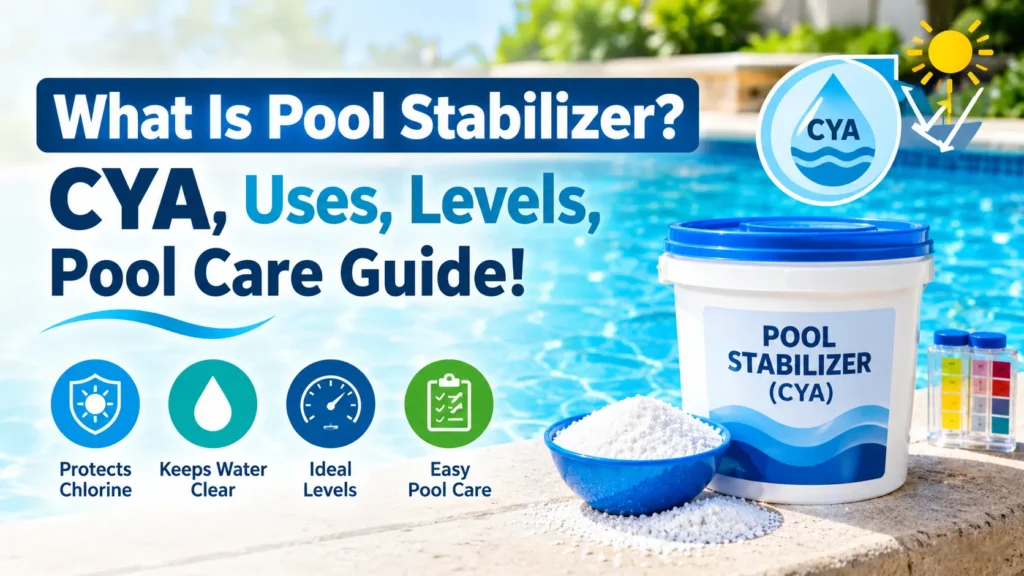
Cyanuric acid, often called CYA or stabilizer, helps protect chlorine from sunlight. However, too much CYA can change how chlorine behaves and may make pool sanitation more difficult to manage.
If your test shows an elevated reading, do not add more stabilizer. First confirm the result with a reliable test and determine how much reduction is actually needed.
Introducing all about how to lower cyanuric acid in pool, For pool owners managing CYA regularly, the [Pool Stabilizer / CYA product page] can also help you find products designed for routine stabilizer management.
What Causes High Cyanuric Acid?
CYA is commonly introduced through certain stabilized chlorine products and through direct addition of pool stabilizer.
Because CYA does not evaporate with pool water, repeated additions can gradually increase the concentration. Splash-out and water replacement can reduce it, but normal evaporation does not remove the dissolved CYA.
This means a pool can have a normal-looking water level while the CYA concentration continues to increase over time.
Regular testing helps identify the problem before you make additional chemical adjustments.
How to Lower Cyanuric Acid in Pool Water
In discovering how to lower cyanuric acid in pool, The most practical method is controlled water replacement.
1. Test the Current CYA Level
Start with an accurate CYA test. Record the current result and compare it with the target range recommended for your specific pool and sanitation system.
If the result seems unusually high, consider confirming it with another reliable test before making a major water change.
2. Determine How Much Reduction Is Needed
The amount of water that needs to be replaced depends on the current CYA level and the desired level.
For example, if a pool has a CYA reading of 100 ppm and the desired level is 50 ppm, replacing approximately half of the water with fresh water can theoretically reduce the concentration to around 50 ppm, assuming the replacement water contains little or no CYA.
Actual results can vary because pool volume estimates, source-water chemistry, and incomplete water replacement affect the final concentration.
3. Replace Water Carefully
Depending on the pool and local conditions, partial draining followed by fresh-water replacement can reduce CYA.
Follow the pool manufacturer’s instructions and local requirements before removing a large amount of water. Some pools, especially certain in-ground structures, may require specific precautions when water levels are lowered.
Do not drain a pool simply because the CYA reading is slightly above your preferred level. Consider the size of the correction and the practical requirements of replacing the water.
How to Reduce Cyanuric Acid in Pool
If you are wondering how to reduce cyanuric acid in pool water without making unnecessary changes, start by calculating the approximate reduction needed.
A simple dilution concept can be useful:
New CYA ≈ Current CYA × Fraction of Original Water Remaining
For example, if the current CYA is 80 ppm and approximately 25% of the water is replaced with fresh water containing negligible CYA:
80 × 0.75 = approximately 60 ppm
This is an estimate rather than a guaranteed final result. Always retest after the water has mixed thoroughly.
What to Do About High Cyanuric Acid in Pool
When dealing with how to lower cyanuric acid in pool water, avoid trying to correct the issue by adding more chlorine stabilizer.
Instead:
- Confirm the CYA test result.
- Check your pool volume.
- Identify the desired CYA level.
- Estimate the required water replacement.
- Follow safe draining and refilling procedures.
- Circulate the fresh water thoroughly.
- Retest CYA before making additional changes.
- Adjust your future chlorine products if they are contributing additional CYA.
This approach prevents you from treating the symptom while continuing to increase the stabilizer level.
Can Filtration Remove Cyanuric Acid?
Standard pool filters are designed to remove suspended particles from the water. They do not normally remove dissolved cyanuric acid from the pool.
Backwashing a sand or DE filter removes some pool water, but it should not be considered a dedicated CYA-reduction method.
If the CYA concentration needs a significant reduction, controlled water replacement is generally the more direct approach.
Should You Stop Adding Stabilized Chlorine?
If your CYA is already elevated, review the chlorine products you are using.
Some stabilized chlorine products add CYA as they dissolve. Continued use can therefore increase the stabilizer concentration over time.
This does not mean stabilized chlorine products are always unsuitable. The right maintenance approach depends on your pool’s chemistry, sanitizer system, and testing routine.
When CYA is already high, consider whether another chlorine product or maintenance approach would better fit your pool.
How Long Does It Take to Lower CYA?
The time required depends on how much water is replaced and how quickly the pool can be safely refilled and circulated.
After refilling, allow the water to mix thoroughly before taking another CYA reading. Testing immediately after adding fresh water may not represent the final concentration throughout the pool.
If the result is still higher than desired, calculate another smaller adjustment instead of making a large change without testing.
Common Mistakes When Lowering CYA
Several mistakes can make CYA management harder:
- Guessing the current CYA level
- Draining more water than necessary
- Ignoring local draining requirements
- Forgetting that evaporation does not remove CYA
- Continuing to add stabilizer when CYA is already high
- Using old or unreliable test results
- Failing to retest after water replacement
A measured approach is usually easier to manage than repeated guesswork.
Frequently Asked Questions
Does CYA evaporate from pool water?
No. CYA remains dissolved in the pool water, so normal evaporation does not remove it. Water replacement is one of the main ways to reduce its concentration.
Can a pool filter remove cyanuric acid?
Standard pool filters generally do not remove dissolved CYA. They are primarily designed to capture suspended particles.
Should I drain the entire pool?
Not necessarily. The required water replacement depends on the current CYA level and desired reduction. Large drainage projects should be approached carefully and according to pool and local requirements.
Can adding more chlorine fix high CYA?
Adding more chlorine does not remove CYA. If the stabilizer level is elevated, the underlying CYA concentration needs to be addressed separately.
Conclusion
Understanding how to lower cyanuric acid in pool water starts with accurate testing and careful planning. When CYA becomes too high, partial water replacement can reduce the concentration, while continued use of CYA-containing products should be reviewed.
Test How to lower cyanuric acid in pool before making a major change, calculate the approximate amount of water replacement required, circulate fresh water thoroughly, and retest afterward. For ongoing stabilizer management and suitable pool products, visit the [Pool Stabilizer / CYA product page].