Quick Answer
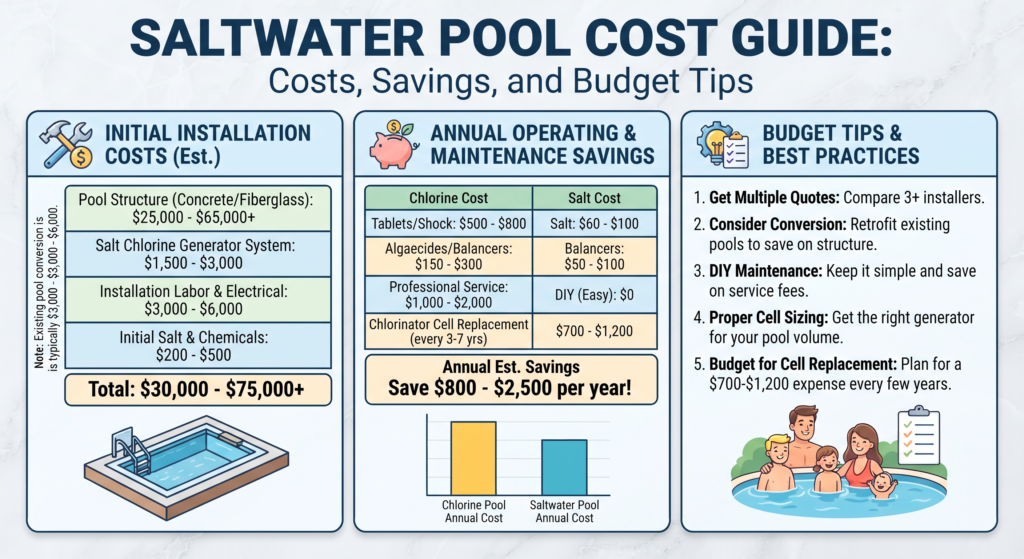
A saltwater pool cost guide helps homeowners estimate the expenses involved in converting, installing, and maintaining a saltwater pool. The initial investment usually includes a salt chlorine generator, installation, and the salt needed to establish the correct concentration. Ongoing expenses can include electricity, water testing, chemicals, cleaning, and eventual salt cell replacement. The actual cost depends on pool size, equipment, location, labor, and maintenance needs. This article will cover all about Saltwater Pool Cost Guide.
What Does a Saltwater Pool Cost?
The total cost depends on whether you are converting an existing chlorine pool or installing a new pool with a saltwater system.
For an existing pool, the biggest expense is usually the salt chlorine generator. Installation costs can also vary depending on whether the existing plumbing and electrical setup can support the new system.
A new pool has a much higher overall cost because the pool construction itself is included in the project. The saltwater equipment becomes only one part of the total investment.
A saltwater pool cost guide should therefore separate upfront expenses from recurring maintenance costs.
| Expense | Typical Cost Type | What Affects It |
| Salt chlorine generator | Upfront | Pool size and system capacity |
| Initial pool salt | Upfront | Pool volume and existing salt level |
| Installation | Upfront | Labor and plumbing requirements |
| Water testing | Ongoing | Testing method and frequency |
| Chemicals | Ongoing | Water chemistry |
| Electricity | Ongoing | Pump and generator runtime |
| Salt cell | Replacement | Model and lifespan |
| Repairs | Occasional | Equipment age and condition |
These categories provide a budgeting framework rather than guaranteed prices because local costs and equipment requirements differ.
Saltwater Pool Conversion Cost
Converting an existing chlorine pool can be significantly less expensive than building a new pool.
The conversion normally involves installing a salt chlorine generator into the existing circulation system. The generator needs to be correctly sized for the pool, and the installation must allow water to pass through the cell properly.
The starting salt level also matters. If the pool already contains some dissolved salt, less additional salt may be needed. If the existing concentration is very low, more salt will be required to reach the generator’s recommended operating range.
When comparing quotes, make sure you know whether the price includes equipment, installation, initial salt, electrical work, and setup.
Convert Pool to Saltwater Cost
The convert pool to saltwater cost depends on pool size, generator capacity, labor, and existing equipment.
| Pool Size | Main Requirement | Relative Cost |
| Small pool | Lower-capacity generator | Lower |
| Medium pool | Standard generator | Moderate |
| Large pool | Higher-capacity generator | Higher |
| Complex installation | Additional plumbing or electrical work | Higher |
The equipment itself can represent a substantial part of the conversion budget. Choosing a system simply because it has the lowest purchase price may not be the best long-term decision.
Instead, compare generator capacity, warranty, replacement cell cost, installation requirements, and expected operating life.
Initial Salt Costs
Salt is another upfront expense when converting to a saltwater system.
The amount required depends on the pool’s water volume and the difference between its current salt concentration and the generator’s target. A larger pool generally requires more salt to achieve the same increase in concentration.
A pool salt cost guide should therefore consider both the price per bag and the number of bags required.
Never add salt based only on an estimate. Test the water first, check the manufacturer’s recommended range, and calculate the required amount based on the actual pool volume.
Ongoing Saltwater Pool Maintenance Costs
A saltwater pool cost guide should not focus only on the conversion price. Long-term maintenance also affects the total ownership cost.
Saltwater pools still require regular testing and cleaning. The generator produces chlorine from dissolved salt, but it does not automatically balance every part of the water chemistry.
You may still need to monitor:
- Free chlorine
- pH
- Total alkalinity
- Cyanuric acid
- Calcium hardness
- Salt concentration
Depending on test results, additional chemicals may occasionally be required.
Electricity and Water Costs
Saltwater systems require electricity because the chlorine generator operates using an electrical current. The generator itself is only one part of the energy cost because the circulation pump also needs to run.
The actual electricity expense depends on pump efficiency, operating hours, electricity rates, and pool equipment.
Water can also contribute to maintenance expenses. Splash-out, backwashing, leaks, and partial draining can cause water loss. When fresh water is added, the salt concentration may change and should be checked again.
Salt Cell Replacement
The salt cell is a wear component and eventually needs replacement.
Its lifespan depends on the specific model, operating hours, water chemistry, cleaning practices, and overall system conditions. Poor water balance and excessive calcium scaling can contribute to performance problems.
When budgeting for a saltwater pool cost guide, include future cell replacement rather than considering only the original equipment price.
| Replacement Consideration | Why It Matters |
| Cell model | Determines compatibility |
| Pool size | Affects required capacity |
| Operating hours | Influences wear |
| Water chemistry | Can affect scaling |
| Cleaning practices | Can affect cell condition |
| Warranty | May reduce replacement expense |
Following the manufacturer’s cleaning and maintenance instructions can help protect the cell.
Saltwater vs Traditional Chlorine Pool Costs
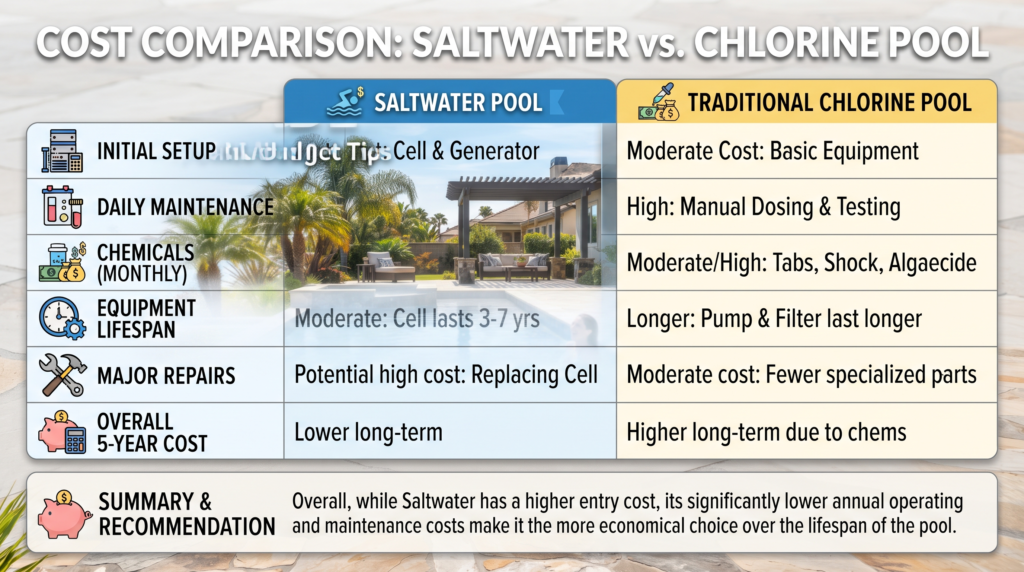
Saltwater and traditional chlorine systems have different cost structures.
A traditional chlorine pool generally has lower equipment costs at the beginning, while the owner purchases and adds sanitizer manually.
A saltwater system usually requires a larger initial investment because of the generator and cell. In return, the system automatically produces chlorine while operating, which can make routine sanitizer management more convenient.
The better option depends on your priorities, pool size, equipment, and expected ownership period.
How to Reduce Saltwater Pool Costs
A good Saltwater Pool Cost Guide should also explain how owners can avoid unnecessary expenses.
Choose the Right System
Select a generator that is appropriately sized for your pool rather than buying based only on the lowest upfront price.
Test Before Adding Salt
Testing prevents unnecessary salt purchases and helps avoid excessive salt concentration.
Maintain Balanced Water
Proper water chemistry can help reduce scaling and protect equipment.
Clean the Cell Correctly
Follow the manufacturer’s cleaning instructions. Aggressive or unnecessary cleaning can damage the cell.
Maintain the Pump and Filter
Good circulation helps the generator work properly and supports overall water quality.
Plan for Replacement Costs
Set aside money for future cell replacement and equipment repairs instead of treating them as unexpected expenses.
Common Budgeting Mistakes
When estimating Saltwater Pool Cost Guide ownership expenses, avoid focusing only on the installation price.
Common mistakes include:
- Ignoring equipment replacement
- Forgetting electricity costs
- Underestimating testing supplies
- Adding salt without testing
- Choosing an incorrectly sized generator
- Ignoring water chemistry
- Comparing systems only by upfront price
Looking at both immediate and long-term expenses provides a more accurate budget.
Frequently Asked Questions
Is a saltwater pool expensive to maintain?
Maintenance costs vary. Saltwater systems can reduce some manual chlorine-handling tasks, but owners still need to test water, maintain equipment, and eventually replace the salt cell.
Is converting a chlorine pool to saltwater worth it?
It can be worthwhile for homeowners who prefer automated chlorine production and less frequent manual sanitizer handling. The value depends on the equipment cost, maintenance preferences, and expected ownership period.
Do saltwater pools need chlorine?
Yes. A saltwater chlorine generator produces chlorine from dissolved salt. Saltwater does not mean the pool is chlorine-free.
Does a saltwater pool use a lot of salt?
The initial amount depends on pool volume and the generator’s recommended concentration. Salt can be lost through water removal and may need occasional replacement.
Is a saltwater pool cheaper than a chlorine pool?
There is no single answer. Saltwater systems generally have higher upfront equipment costs, while traditional chlorine systems may have different ongoing sanitizer expenses. Compare total ownership costs rather than one expense.
Conclusion
A saltwater pool cost guide helps homeowners understand the complete financial picture of owning or converting to a saltwater pool. The budget should include the generator, installation, initial salt, testing, electricity, maintenance, and eventual cell replacement.
Covering all the details about Saltwater Pool Cost Guide, the most effective way to control costs is to choose appropriately sized equipment, test water before making adjustments, maintain balanced chemistry, and keep the circulation system in good condition. Looking at both upfront and long-term expenses makes it easier to create a realistic saltwater pool budget.