Quick Answer
A pool chemical cost calculator helps estimate how much you may spend on the chemicals needed to maintain your swimming pool. It can help you plan expenses for chlorine, salt, pH adjusters, alkalinity products, stabilizer, and other water treatment products. Your actual cost depends on pool size, water chemistry, chemical type, product concentration, pool usage, weather, and local prices. This article will cover all about Pool Chemical Cost Calculator.
What Is a Pool Chemical Cost Calculator?
A pool chemical cost calculator is a budgeting tool that estimates the cost of maintaining your pool chemistry based on the products you use and how often they are needed.
Instead of looking only at the price of one chemical, you can consider several recurring products together. This gives you a better idea of your weekly, monthly, or seasonal chemical budget.
Pool Chemical Cost Calculator requirements are not identical for every pool. A 10,000 gallon pool and a 30,000 gallon pool will generally require different amounts of products, while heavy swimmer use and hot weather can also increase chemical demand.
What Pool Chemicals Affect Your Budget?
Several products may contribute to your total Pool Chemical Cost Calculator expenses.
| Chemical | Main Purpose | Cost Frequency |
| Chlorine | Sanitizing pool water | Regular |
| Pool salt | Supports saltwater chlorine generation | Occasional |
| pH increaser | Raises low pH | As needed |
| pH reducer | Lowers high pH | As needed |
| Alkalinity increaser | Raises alkalinity | As needed |
| Cyanuric acid | Protects chlorine from sunlight | Periodic |
| Calcium hardness increaser | Raises calcium hardness | As needed |
| Pool shock | Handles high sanitizer demand | Occasional |
Not every pool needs every product every week. Testing should determine which chemicals actually require adjustment.
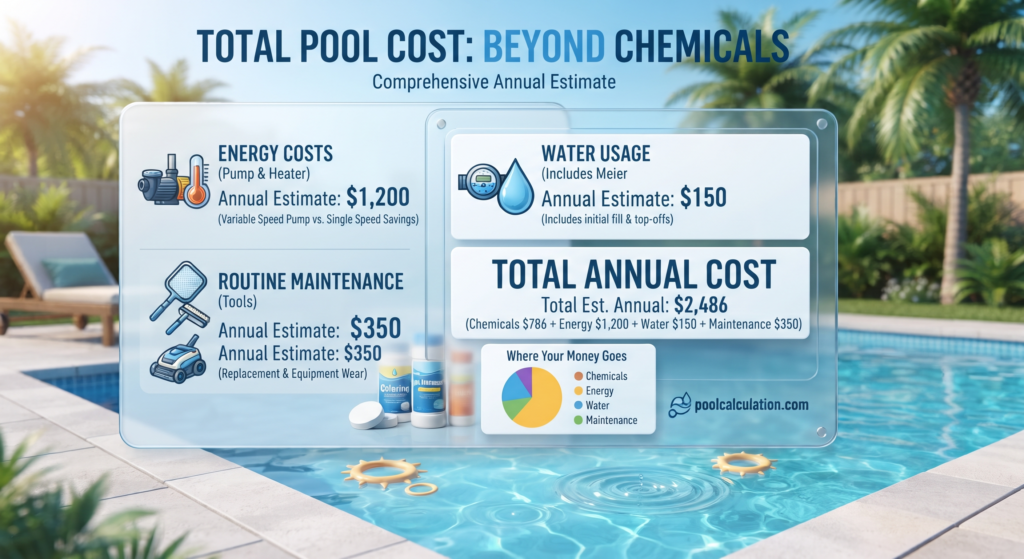
How to Estimate Pool Chemical Costs
The basic process is simple.
1. Determine Pool Volume
Start with the approximate amount of water in your pool. Accurate volume is important because chemical dosage is normally based on the amount of water being treated.
2. Test Your Water
Check the chemistry before purchasing or adding products. Depending on your pool, you may test free chlorine, pH, alkalinity, stabilizer, calcium hardness, and salt.
3. Identify Required Chemicals
Use your test results to determine which levels need adjustment. Avoid buying products simply because they are commonly used.
4. Check Product Dosage
Read the product label and determine how much is required for your pool volume and current reading.
5. Calculate Product Cost
Multiply the amount required by the cost per unit of the product. This gives you an estimated expense for that adjustment.
Example Chemical Cost Table
The following example shows how a homeowner might organize a basic chemical budget.
| Product | Example Quantity | Example Price | Estimated Cost |
| Chlorine | 1 container | $25 | $25 |
| pH adjuster | 1 container | $15 | $15 |
| Alkalinity product | 1 container | $18 | $18 |
| Stabilizer | 1 container | $20 | $20 |
| Pool shock | 1 package | $30 | $30 |
| Salt | 4 bags | $10 each | $40 |
Example total: $148
These figures are examples for budgeting only. Actual prices vary by product, package size, location, concentration, and retailer.
How Much Is Pool Salt?
If you operate a saltwater pool, you may ask how much is pool salt before calculating your maintenance budget.
The price varies according to bag size, product quality, location, and retailer. Pool owners should also consider how many bags are needed rather than looking only at the price of one bag.
The amount of salt required depends on pool volume and the difference between the current salt level and the target recommended by your saltwater chlorine generator.
Always test the existing salt concentration before adding more. Adding salt without testing can result in an unnecessarily high concentration.
Chlorine Costs and Pool Usage
Chlorine can represent a significant recurring expense, especially in pools with heavy use.
Chlorine demand may increase because of:
- Frequent swimming
- High temperatures
- Strong sunlight
- Rainfall
- Organic contamination
- Algae growth
- Incorrect stabilizer levels
A pool that receives frequent use may therefore consume more sanitizer than a lightly used pool of the same size.
This is one reason a pool chemical cost calculator should be used as an estimate rather than a guaranteed monthly expense.
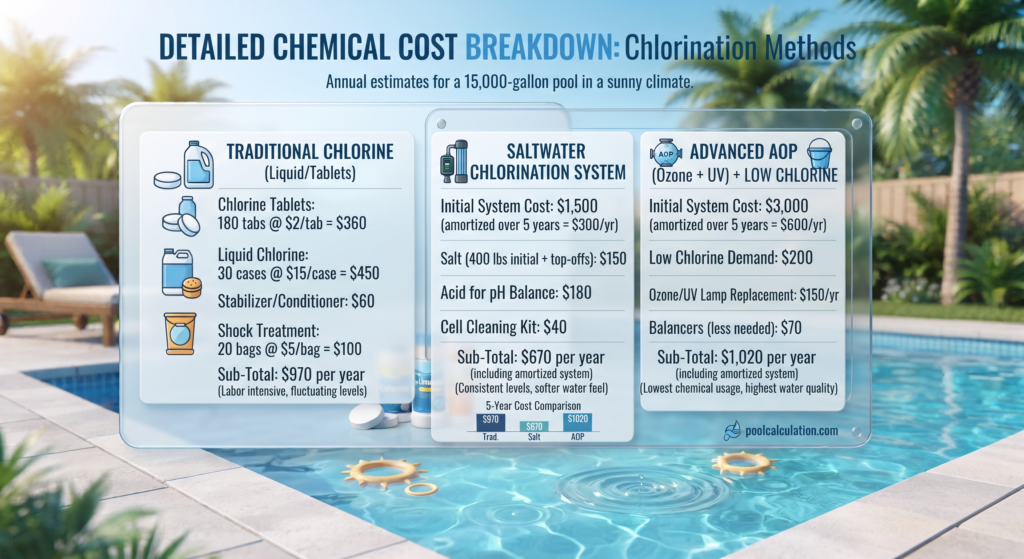
Saltwater vs Traditional Chlorine Costs
Saltwater and traditional chlorine pools have different cost structures.
A traditional chlorine pool usually requires regular purchases of chlorine products. A saltwater system uses a salt chlorine generator to produce chlorine from dissolved salt.
Saltwater systems can reduce the frequency of manually adding chlorine, but they still require testing and water balancing. They also have equipment expenses, including eventual salt cell replacement.
When comparing systems, consider the complete cost rather than focusing on one chemical.
How to Reduce Pool Chemical Costs
A pool chemical cost calculator can help you understand where your money is going, but good maintenance habits can also reduce unnecessary spending.
Test Before Adding Chemicals
Testing prevents you from adding products that your pool does not need.
Use Correct Dosages
Adding more chemical than necessary wastes money and can create additional water chemistry problems.
Maintain Proper Water Balance
Keeping pH, alkalinity, sanitizer, and other important levels within appropriate ranges can make chemical management more predictable.
Keep the Pool Clean
Removing leaves, debris, and contaminants can reduce unnecessary sanitizer demand.
Maintain Pool Equipment
Good circulation and filtration help distribute chemicals and support overall water quality.
Should You Buy Pool Chemicals in Bulk?
Buying larger quantities can sometimes reduce the cost per unit, but bulk purchasing is not always the best choice.
Before you buy pool salt or another chemical in a large quantity, consider storage conditions, product shelf life, expected usage, and whether your pool actually needs that amount.
Chemicals should always be stored according to the manufacturer’s instructions and kept safely away from incompatible materials, children, and pets.
Monthly Chemical Budget Planning
A useful way to plan expenses is to divide chemical spending into regular and occasional categories.
| Expense Type | Examples | Planning Approach |
| Regular | Chlorine, sanitizer | Monthly budget |
| Occasional | Pool shock | Reserve amount |
| Chemistry adjustment | pH, alkalinity | Variable budget |
| Seasonal | Stabilizer, salt | Plan ahead |
| Unexpected | Extra treatment | Emergency reserve |
Keeping a small reserve is useful because pool chemistry can change unexpectedly after heavy rain, extreme heat, or unusually high swimmer activity.
Common Cost Calculation Mistakes
Avoid these mistakes when estimating your Pool Chemical Cost Calculator budget:
- Using the wrong pool volume
- Ignoring product concentration
- Adding chemicals without testing
- Comparing different package sizes directly
- Forgetting occasional treatments
- Ignoring seasonal chemical demand
- Buying unnecessary products
- Assuming every pool has identical chemical requirements
Accurate measurements make your cost estimate much more useful.
Frequently Asked Questions
Does pool size affect chemical costs?
Yes. Larger pools generally require larger quantities of chemicals when an adjustment is needed.
Are pool chemicals a monthly expense?
Some chemicals may be purchased regularly, while others are only needed occasionally. Usage depends on water chemistry, pool size, weather, and swimmer activity.
Can saltwater pools eliminate chemical costs?
No. Saltwater systems produce chlorine from salt, but owners still need to test and balance the water and maintain the equipment.
Conclusion
A pool chemical cost calculator provides a practical way to estimate the money needed for routine pool water treatment. By considering pool volume, current chemistry, product dosage, package prices, and expected usage, you can create a more realistic maintenance budget.
Covering all the aspects about Pool Chemical Cost Calculator, Test your water before adding chemicals, use the correct dosage, and separate regular expenses from occasional treatments. This approach can help reduce waste, prevent unnecessary purchases, and make your overall pool maintenance costs easier to manage.