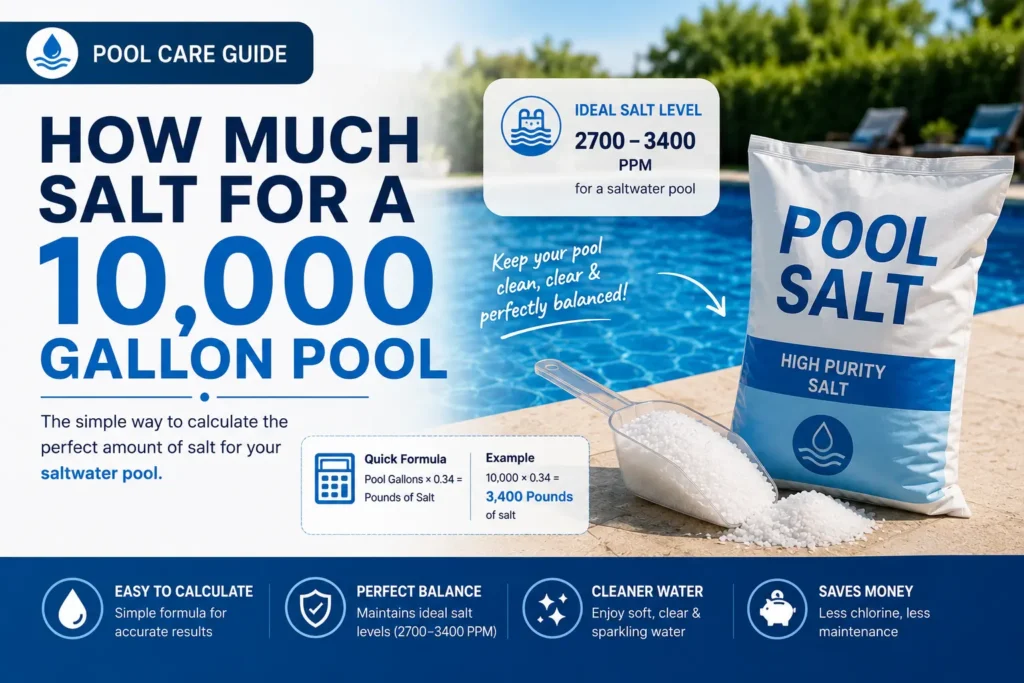
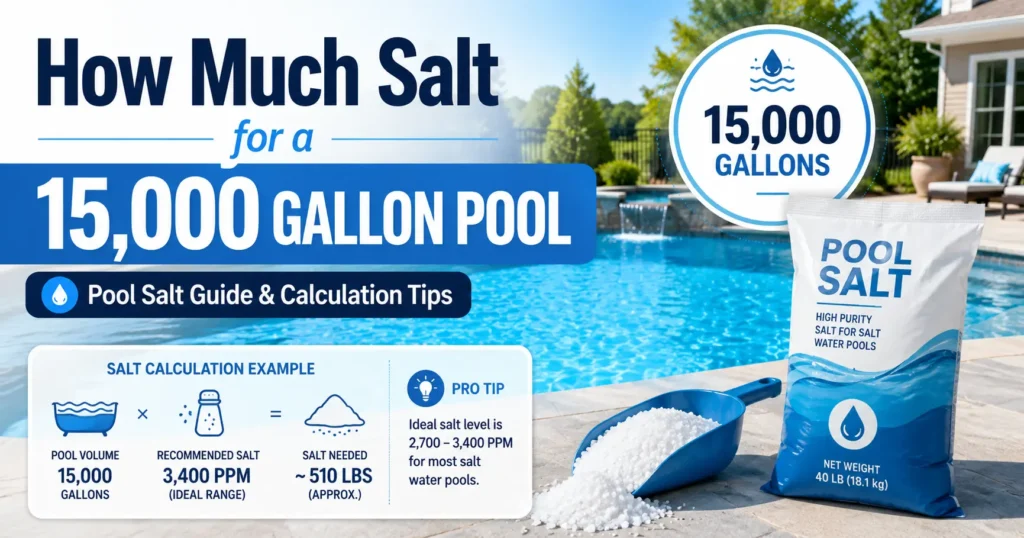
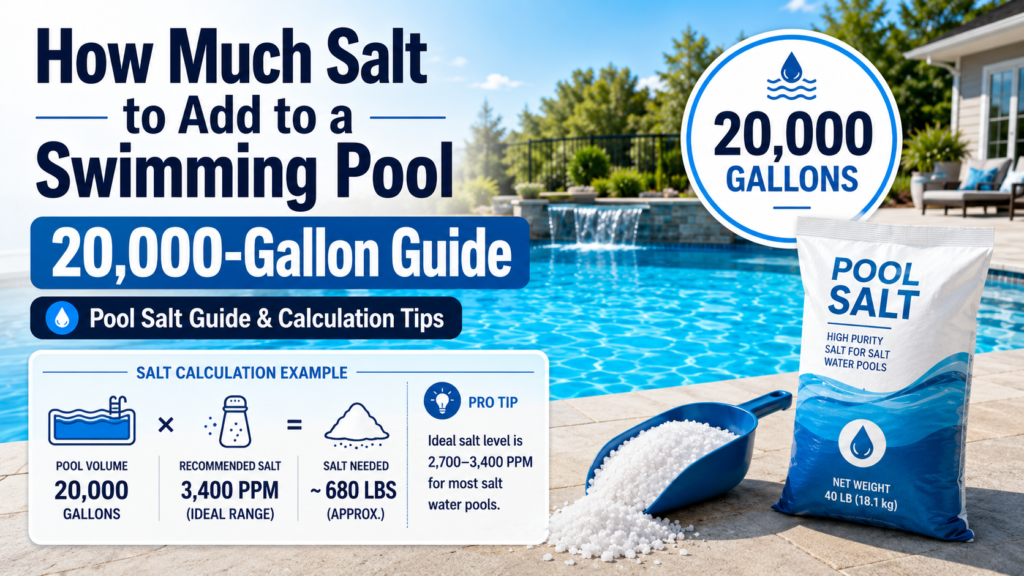
| Quick Answer The ideal salt level for pool water is the target range specified by the installed salt chlorine generator. Many residential systems operate near 3000 to 3500 ppm, but some models use a lower or higher range. The owner’s manual is the final reference. |
Introduction
Ideal Salt Level For Pool: this article gives a practical overview before the detailed steps, examples, and safety guidance below.
What Should the Salt Level Be in a Saltwater Pool
When people ask about the recommended salt range, they often expect one universal number. Salt systems are designed differently, so the correct answer is a range tied to the cell and control unit. A popular target is around 3200 ppm, yet some above ground units operate closer to 3000 ppm and other systems permit higher levels.
Use the middle of the manufacturer range as a practical target. This leaves room for small testing differences, rainfall, splash out, and seasonal water replacement.
Why Pool Salt Levels Matter
Salinity levels affect the electrical conductivity the cell uses to generate chlorine. When salinity is below the operating range, chlorine output may fall or the system may stop. When it is too high, the control can show a warning, shut down, or operate outside the design limit. Ideal Salt Level For Pool: start with current measurements and reliable test results.
Salt is only one part of water care. A perfect salinity reading does not guarantee safe chlorine, pH, stabilizer, or circulation.
Typical Salt Level Guide
| Reading | General Meaning | Recommended Action |
| Below system minimum | Cell may reduce or stop chlorine production | Confirm with a second test, then calculate salt |
| Near lower end | System may work but has little room for dilution | Monitor and add only if the manual supports it |
| Middle of range | Best operating cushion for many systems | Maintain and test after water loss |
| Near upper end | Avoid adding more salt | Confirm accuracy before any change |
| Above maximum | Warning or shutdown may occur | Confirm and plan dilution |
How to Test the Pool Salinity
Compare the salt cell display with an independent test. Options include salt test strips, a drop test, and a calibrated digital meter. Sample water away from return jets and do not test immediately after adding salt.
Temperature can influence some generator readings. Scale on the cell and calibration differences can also create a gap between the display and the water test.
Signs the Salt Level Is Low
- A low salt warning on the control panel.
- Reduced chlorine production even though run time has not changed.
- Free chlorine falling during normal weather and swimmer load.
- A confirmed independent salinity test below the equipment minimum.
Signs the Salt Level Is High
- A high salt warning or conductivity error.
- Cell shutdown or unusual control behavior.
- A salty taste that is stronger than normal.
- Corrosion concerns around vulnerable metals, especially when water balance is also poor.
Use the Pool Salt Calculator
Use the Pool Salt Calculator after testing. Enter the pool volume, current reading, target reading, and bag size. The result shows how much salt is required without forcing the level to the top of the range. Ideal Salt Level For Pool: make changes gradually and verify the outcome.
If the reading is already high, do not enter a higher target. High salt is usually corrected by replacing part of the water, not by adding another chemical.
Seasonal Changes
Rain only lowers salinity when it causes overflow or water removal. Evaporation concentrates salt because the water leaves while salt remains. Backwashing, leaks, and splash out lower the amount over time.
Record readings before and after major water events. A simple log makes unusual changes easier to identify.
Common Errors
- Using another pool owner's target without checking the installed system.
- Keeping the level at the maximum instead of near the middle.
- Adding salt because free chlorine is low without testing salinity.
- Trusting a single unexpected reading.
- Cleaning or replacing the cell before checking water chemistry and flow.
Choosing a Practical Target Inside the Range
The middle of the approved range is usually more useful than the minimum or maximum. A middle target gives the cell room to keep operating after rainfall, backwashing, or small testing differences. It also avoids adding salt simply to reach the highest number shown in the manual. Ideal Salt Level For Pool: repeat the check whenever conditions change.
Record the chosen target beside the system model in the maintenance log. This prevents another person from using a generic target from a different brand. When the equipment is replaced, review the new manual because the ideal operating range may change. Ideal Salt Level For Pool: follow the product label and equipment instructions.
Frequently Asked Questions
Is 3000 ppm enough salt for a pool?
It may be enough for a system whose operating range includes 3000 ppm. Check the manual.
Is 4000 ppm too high?
It is too high for some generators and acceptable for others. Confirm the model limit.
How often should salt be tested?
Test periodically and after major rain overflow, backwashing, leaks, draining, or large water replacement.
Does a saltwater pool still need chlorine testing?
Yes. The salt cell produces chlorine, and free chlorine must still be measured.
Can low salt damage the cell?
Operating outside the manufacturer range can affect performance and may contribute to cell problems. Follow the manual.
Why does the system show low salt when the test is normal?
Cold water, cell scale, calibration, flow, or an aging cell can affect the displayed value.
Conclusion
The ideal salt level for pool water is not one fixed number. Use the target range for the installed generator, aim near the middle, confirm with an independent test, and use the Pool Salt Calculator only when the measured level is below target. Record the pool salt level after full circulation so the next adjustment is based on a confirmed reading.