| Quick Answer For a 10000 gallon pool, raising salt by 1000 ppm requires about 83 pounds of pure pool salt. The correct amount depends on the current salt reading and the target listed in the salt system manual. Test first, calculate the difference, add most of the dose, circulate, and retest. |
Start with the Current Salt Reading
Knowing how much salt to add to pool water starts with two numbers: the current salinity and the target salinity. A pool that already contains 2600 ppm needs far less salt than freshly filled water. Salt can remain from a previous season, liquid chlorine, source water, and earlier treatments, so assuming the starting level is zero often leads to an excessive dose.
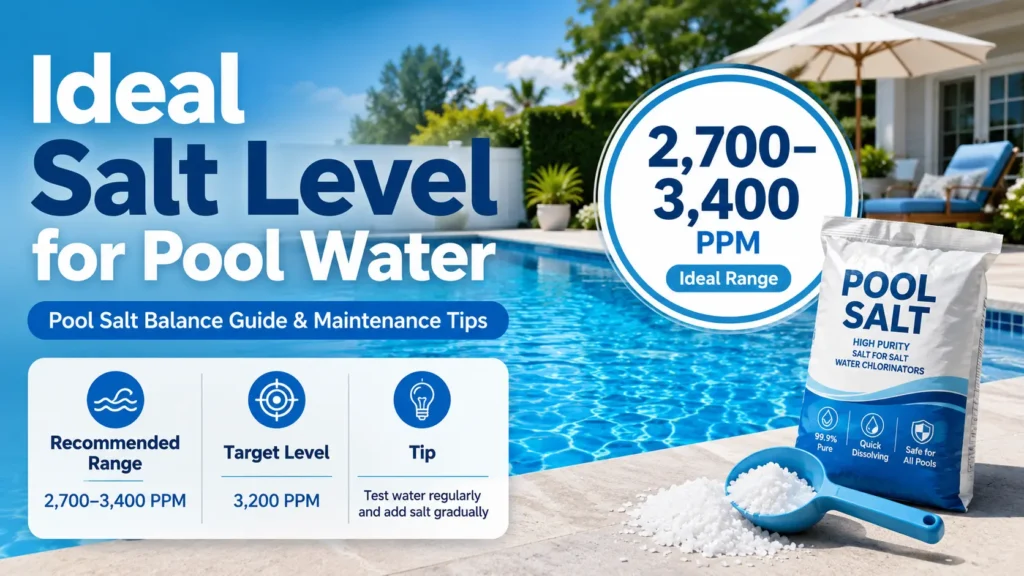
For a standard 10000 gallon pool, use a reliable salt test and compare the result with the operating range in the chlorine generator manual. Many systems work near 3000 to 3500 ppm, but the correct target belongs to the installed model. The system display is useful, although an independent test is wise before adding several bags.
Use the Pool Salt Calculator
Use the Pool Salt Calculator to enter 10000 gallons, the current ppm, the target ppm, and the bag size. The tool converts the required increase into pounds, kilograms, and bags. This is the simplest way to answer how much salt for pool startup, seasonal correction, or replacement water.
The basic calculation is pool gallons multiplied by the required ppm increase, then multiplied by 0.00000834. In a 10000 gallon pool, every 100 ppm increase needs about 8.34 pounds of salt.
Salt Chart for a 10000 Gallon Pool
| Required Increase | Salt Needed | 40 Pound Bags |
| 500 ppm | 41.7 pounds | 1.04 bags |
| 1000 ppm | 83.4 pounds | 2.09 bags |
| 1500 ppm | 125.1 pounds | 3.13 bags |
| 2000 ppm | 166.8 pounds | 4.17 bags |
| 2500 ppm | 208.5 pounds | 5.21 bags |
| 3000 ppm | 250.2 pounds | 6.26 bags |
Practical Example
Suppose the pool tests at 1800 ppm and the system target is 3200 ppm. The required increase is 1400 ppm. Multiply 10000 by 1400 and by 0.00000834. The result is about 116.8 pounds, which is just under three 40 pound bags.
Instead of emptying all three bags at once, add about two and a half bags, brush the floor, and run the pump. Retest after the water is fully mixed. Add the remaining amount only when the new reading confirms it is needed.
How to Add the Salt
1. Confirm the pool volume and take a fresh salinity reading.
2. Check the salt system manual for the target and high salt limit.
3. Calculate the dose with the Pool Salt Calculator.
4. Turn the chlorine generator off during addition if the manual instructs you to do so, while keeping circulation available.
5. Spread pool grade salt across the shallow area or pool perimeter instead of pouring it into the skimmer.
6. Brush undissolved crystals so they do not remain in one place.
7. Allow full circulation, retest, and then complete the adjustment.
How Much Salt to Put in Pool Water After Rain or Backwashing
Heavy rain can lower salinity when the pool overflows or water is pumped out. Backwashing, splash out, leaks, and partial draining also remove salt. Evaporation alone does not remove it. Water leaves, but the dissolved salt remains.
When deciding how much salt to put in pool water after a storm, test again instead of using the amount added last time. The lost volume and the new ppm reading determine the correction.
Common Mistakes
· Adding salt because chlorine is low without checking whether the salt level is already correct.
· Using the advertised pool size when the real water volume is smaller.
· Copying another brand's salt target.
· Pouring concentrated salt into the skimmer.
· Adding the complete calculated dose before allowing for test and volume error.
· Restarting the salt cell before the product is dissolved and the manual allows it.
Related Tools
Use the Pool Volume Calculator when 10000 gallons is only an estimate. Use the Pool Chlorine Calculator when sanitizer is low but salinity is already in range. The Pool pH Calculator is also useful because salt systems often need regular pH attention.
Frequently Asked Questions
How many bags of salt are needed for a 10000 gallon pool?
The answer depends on the ppm increase. A 1000 ppm increase needs about 83 pounds, or a little more than two 40 pound bags.
How much salt does a new 10000 gallon pool need?
If the true starting level is zero and the target is 3200 ppm, the estimate is about 267 pounds. Test first because source water may already contain salt.
Can I add three bags of salt at once?
You can add a large portion when the calculation supports it, but holding back part of the final bag reduces the risk of overshooting.
How long should the pump run after adding salt?
Follow the salt and equipment labels. The water should circulate until the crystals are dissolved and the reading is stable.
Does low chlorine always mean low salt?
No. Low chlorine can come from short run time, low cell output, sunlight, algae, low stabilizer, cold water, or a cell problem.
Can regular table salt be used?
Use salt approved for pools and the salt system. Avoid products with anti caking agents, iodine, color, or unwanted additives.
Conclusion
The safest answer to how much salt to add to a pool is based on a measured starting level, not a fixed bag rule. For 10000 gallons, every 1000 ppm increase needs about 83 pounds. Use the Pool Salt Calculator, add most of the estimate, circulate, and retest before finishing.