| Quick Answer The best salt for saltwater pool use is high purity sodium chloride that is labeled for pools, dissolves cleanly, and contains no iodine, color, fragrance, or unwanted anti caking additives. Check the salt system manual before buying. |
Introduction
Choosing the right salt for saltwater pool systems affects both water quality and how long your cell lasts. Below you will find the main salt types, comparisons, and buying advice.
What Makes Pool Salt a Good Choice
Good salt for saltwater pool is simple. Look for a high percentage of sodium chloride, clean white crystals, clear labeling, and compatibility with salt chlorine generators. The product should dissolve without leaving visible dirt, color, or oily residue.
Salt for salt water pool care is not chosen by brand name alone. Purity, processing, crystal size, storage condition, and package integrity matter more.
Common Types of Salt
| Salt Type | Advantages | Concerns |
| Pool grade evaporated salt | High purity and fast dissolution | May cost more than basic solar salt |
| Solar salt crystals | Common and economical | Inspect for visible impurities and slower crystals |
| Fine pool salt | Dissolves quickly | Can clump if stored in moisture |
| Water softener salt | Sometimes high purity | Use only when the label and equipment manual allow it |
| Rock salt | Low cost | Often contains impurities and is usually a poor pool choice |
| Table salt | Widely available | Iodine and additives make it unsuitable |
Ingredients to Avoid
· Iodine or iodized salt.
· Yellow prussiate of soda or other anti caking agents when the pool or equipment guidance advises against them.
· Rust inhibitors, fragrances, colors, or cleaning additives.
· Products containing visible dirt, mineral pieces, or moisture damage.
· Salt blends that do not clearly state the sodium chloride content.
How Many Bags of Salt for Pool Startup
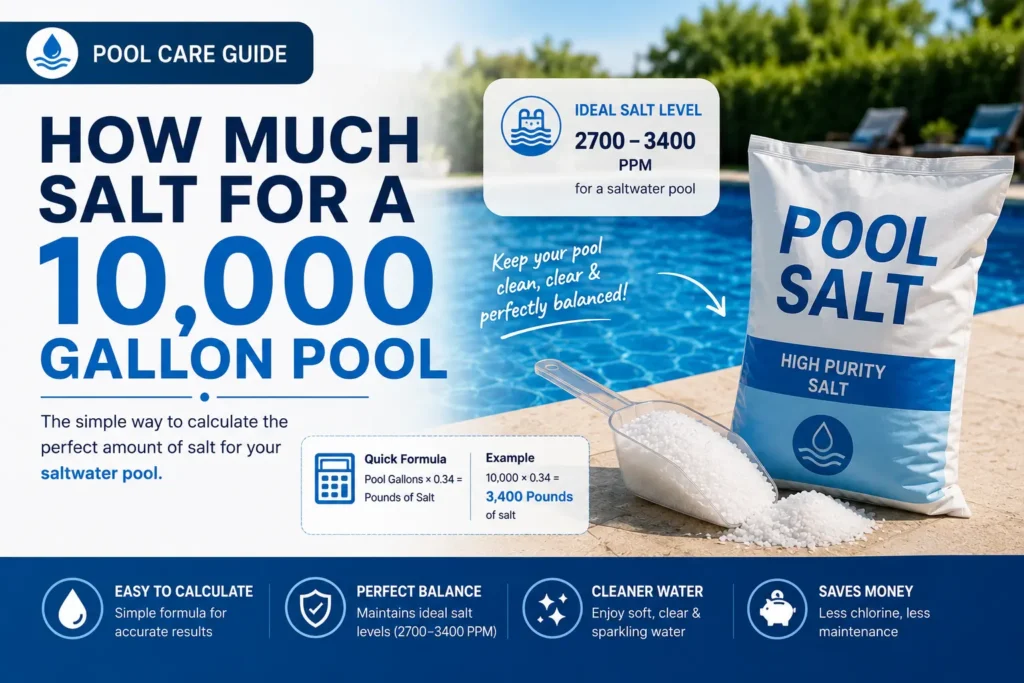
The number of pool-salt bags needed for startup depends on water volume, current salinity, target salinity, and bag weight. A 10000 gallon pool starting near zero and targeting 3200 ppm needs roughly 267 pounds, or about 6.7 bags of 40 pounds.
Use the Pool Salt Calculator instead of buying from a generic bag chart. It can convert the result into 20, 25, or 40 pound packages. As this salt for saltwater pool recommends, compare purity, compatibility, package size, and delivered cost.
Crystal Size and Dissolving Speed
Fine crystals normally dissolve faster than large crystals, especially with warm water, strong circulation, and brushing. Faster is convenient, but purity remains more important than crystal size.
Do not leave any product in a concentrated pile. Spread it across the pool as directed and brush until the floor is clear.
Packaging and Storage
Choose sealed bags without tears, wet corners, or hardened blocks. Store extra pool salt for saltwater pool use in a dry location away from metal tools, chlorine, acid, and electrical equipment.
Bulk purchasing can reduce cost, but only buy what can be stored properly. Damp bags become difficult to handle and may damage nearby surfaces.
Buying Checklist
· Pool use stated clearly on the bag.
· High sodium chloride purity.
· No iodine, color, fragrance, or unwanted additives.
· Bag size that matches the calculator result.
· Clean, dry, undamaged packaging.
· Price compared by cost per pound, not only cost per bag.
· Availability for future matching purchases.
What Competitor Buying Guides Often Miss
A product recommendation is incomplete without a salinity test. Even the best salt can create a problem when the starting level is unknown. It is also important to separate salt quality from water balance. Salt does not correct low chlorine caused by algae, low stabilizer, poor circulation, or cell failure. As this salt for saltwater pool outlines, check manufacturer specifications before purchasing.
How to Compare Two Pool Salt Products
Place the labels side by side and compare sodium chloride purity, additives, bag weight, price per pound, and storage condition. A less expensive bag can be the better choice when it is clean and high purity, while a premium label does not justify unwanted additives or damaged packaging.
Also consider how the product will be used. Fine crystals are convenient for a small correction, while a larger startup purchase may be chosen for price and availability. The correct amount still comes from the Pool Salt Calculator, not from the number of bags displayed in a store promotion.
Pool Salt Products That Need Extra Caution
Avoid any product with an unclear ingredient list or a label that is intended only for deicing, food use, or an unrelated industrial purpose. Salt that contains visible minerals, iron, dirt, or color can leave residue and may contribute to staining.
When a water softener product appears suitable, confirm its purity and additives with the label and salt system guidance. A familiar product category is not proof that every bag in that category is appropriate for a pool.
Frequently Asked Questions
Can water softener salt be used in a pool?
Only when it is high purity sodium chloride without unwanted additives and the pool and equipment guidance allow it.
Is all pool salt the same?
No. Purity, additives, crystal size, cleanliness, and storage quality vary.
Are fine crystals better?
They usually dissolve faster, but high purity and suitable ingredients matter more.
How many bags should I buy?
Use the Pool Salt Calculator with current and target ppm. Buy enough for the estimate but add in stages. As this salt for saltwater pool explains, match the quantity to the calculation and storage plan.
Can salt stain a pool?
Impurities and concentrated piles may contribute to surface problems. Use clean pool grade salt and brush it promptly.
Does expensive salt produce more chlorine?
Not when purity and sodium chloride content are similar. The cell responds mainly to salinity and operating conditions.
Conclusion
Choose clean, high purity salt for saltwater pool use and avoid iodine, color, fragrance, and questionable additives. Use the Pool Salt Calculator to determine the number of bags, then add the product according to the salt and equipment labels.