| Quick Answer A salt for above ground pool system setup needs a compatible chlorine generator, correct water volume, pool grade salt, good circulation, and corrosion checks. The target salt level comes from the system manual, not from the pool size alone. |
Introduction
Setting up a salt for above ground pool system follows the same principles as in-ground pools, with a few size-specific tweaks. This guide gives a practical overview before the detailed setup steps below.
How an Above Ground Salt System Works
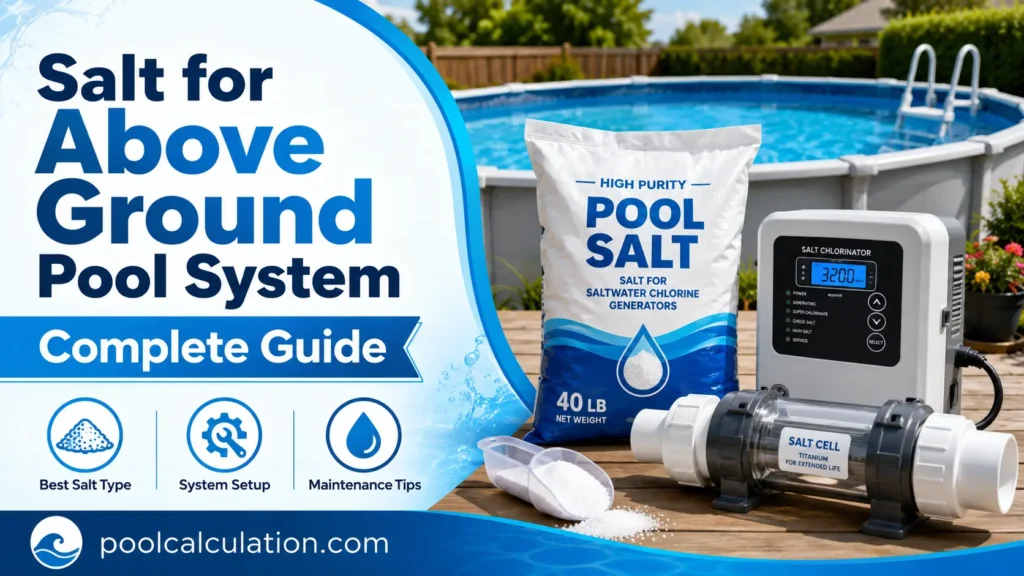
An above ground pool salt filter is often described as if salt replaces chlorine. In reality, the cell uses electricity to convert dissolved salt into chlorine. The filter still removes particles, while the salt system handles sanitizer production.
Some packages combine the pump, filter, and generator. Other pools use a separate salt water pump for above ground pool installation with a cell added after the filter.
Check Pool Compatibility First
Salt can increase corrosion concerns around steel walls, frames, ladders, screws, rails, and electrical components. Confirm that the pool manufacturer allows a salt system and follow any limits for salinity and equipment. As this salt for above ground pool system explains, start with current measurements and reliable test results.
Inspect metal regularly and repair coating damage. Good bonding, splash control, and balanced water are as important as the salt reading.
Choose the Right System Size
Size the generator for actual water volume and expected chlorine demand. A unit working at its maximum rating may struggle during high heat, heavy use, or long sunny days.
Review minimum flow, connection size, pump schedule, water temperature limits, warranty, and replacement cell availability before buying.
How Much Salt Is Needed
Salt for swimming pools is calculated from current ppm, target ppm, and water volume. A common 5000 gallon above ground pool needs about 133 pounds to rise from zero to 3200 ppm. A pool with an existing reading of 1500 ppm needs much less.
Use the Pool Salt Calculator and the target listed for the specific system.
Typical Salt Amounts from Zero
| Pool Volume | Target 3000 ppm | Target 3200 ppm |
| 3000 gallons | 75.1 pounds | 80.1 pounds |
| 5000 gallons | 125.1 pounds | 133.4 pounds |
| 8000 gallons | 200.2 pounds | 213.5 pounds |
| 10000 gallons | 250.2 pounds | 266.9 pounds |
| 15000 gallons | 375.3 pounds | 400.3 pounds |
Setup Steps
62. Level and assemble the pool according to its instructions.
63. Install the pump, filter, and salt cell in the required flow direction.
64. Confirm electrical protection, grounding, and bonding.
65. Fill and circulate the water.
66. Test the starting salinity and complete chemistry.
67. Balance pH, alkalinity, calcium, and stabilizer as required.
68. Calculate and add pool grade salt.
69. Brush until dissolved and retest.
70. Start the generator under the manual instructions.
71. Measure free chlorine daily during the first adjustment period.
Maintenance Priorities
· Test free chlorine and pH several times each week during active use.
· Check salinity periodically and after water replacement.
· Clean baskets and maintain normal filter flow.
· Inspect metal parts for early corrosion.
· Check the cell for scale only as the manual recommends.
· Adjust output based on test results, not appearance alone.
· Winterize the pool and cell for the local climate.
Common Problems
| Problem | Likely Cause | First Step |
| Low chlorine | Short run time, low output, algae, low CYA, cold water | Test full chemistry |
| Low salt warning | True dilution, cold water, scale, sensor issue | Confirm independently |
| Corrosion | Splash, damaged coating, poor balance, incompatible metal | Inspect and correct cause |
| Cloudy water | Low sanitizer, poor filtration, chemistry imbalance | Test and improve circulation |
| Cell scale | High pH, high calcium, saturation imbalance | Review water balance |
Buying Considerations
Look beyond initial price. Compare cell output, warranty terms, replacement cost, controls, diagnostic information, installation parts, and support. A low cost system becomes expensive when replacement cells are unavailable. As this salt for above ground pool system recommends, make changes gradually and verify the outcome.
Protecting Metal Parts Around the Pool
Rinse salt splash from rails, ladders, fasteners, and nearby equipment. Inspect scratches, chipped coatings, and rust spots before they spread. Do not allow wet salt bags or concentrated water to remain against the pool wall.
Compatibility is a construction issue as well as a chemistry issue. A correct salt reading cannot protect unsuitable or damaged metal. Follow the above ground pool manufacturer instructions and repair exposed surfaces promptly.
Daily Checks During the First Week
After startup, test free chlorine and pH each day until the output setting and pump schedule are stable. Look for leaks at hose connections and confirm that the cell receives normal flow. Check metal rails and fasteners for salt splash. As this salt for above ground pool system outlines, repeat the check whenever conditions change.
A new system may need several small output changes. Avoid changing salt, run time, and output at the same time because it becomes difficult to identify which adjustment solved the problem. As this salt for above ground pool system explains, follow the product label and equipment instructions.
Frequently Asked Questions
Can any above ground pool use saltwater?
Only when the pool structure, liner, metal components, equipment, and warranty are compatible.
Is a salt filter the same as a sand filter?
No. The filter removes particles. The salt cell generates chlorine.
How much salt does a 5000 gallon pool need?
From zero to 3200 ppm, about 133 pounds. Test first.
Will salt rust an above ground pool?
Salt can increase corrosion risk on exposed or incompatible metal. Inspection and proper construction are important.
Does the salt system run whenever the pump runs?
Operation depends on the system controls, flow, schedule, and output setting.
Can the cell work in cold water?
Many systems reduce or stop production below a temperature threshold. Check the manual.
Conclusion
A salt for above ground pool system can provide convenient chlorine production when the pool and equipment are compatible. Choose the right size, protect metal components, calculate salt accurately, and test free chlorine instead of relying only on the control panel.