Quick Answer
A pool cover size calculator helps you estimate the correct cover dimensions based on your pool’s length, width, shape, and required overlap. Choosing the right size is important because a cover that is too small may leave parts of the pool exposed, while an unnecessarily large cover can be difficult to handle and secure. We will cover all about Pool Cover Size Calculator in this article.
What Is a Pool Cover Size Calculator?
A pool cover size calculator is a simple tool that helps pool owners determine how large a pool cover should be.
The calculation usually starts with the pool’s basic dimensions. Depending on the cover type, you may also need to account for extra material around the pool edges.
The required cover size can vary based on:
- Pool length
- Pool width
- Pool shape
- Cover type
- Required overlap
- Attachment or anchoring method
- Pool surroundings
Getting these measurements right before purchasing a cover can save money and prevent installation problems.
Why Does Pool Cover Size Matter?
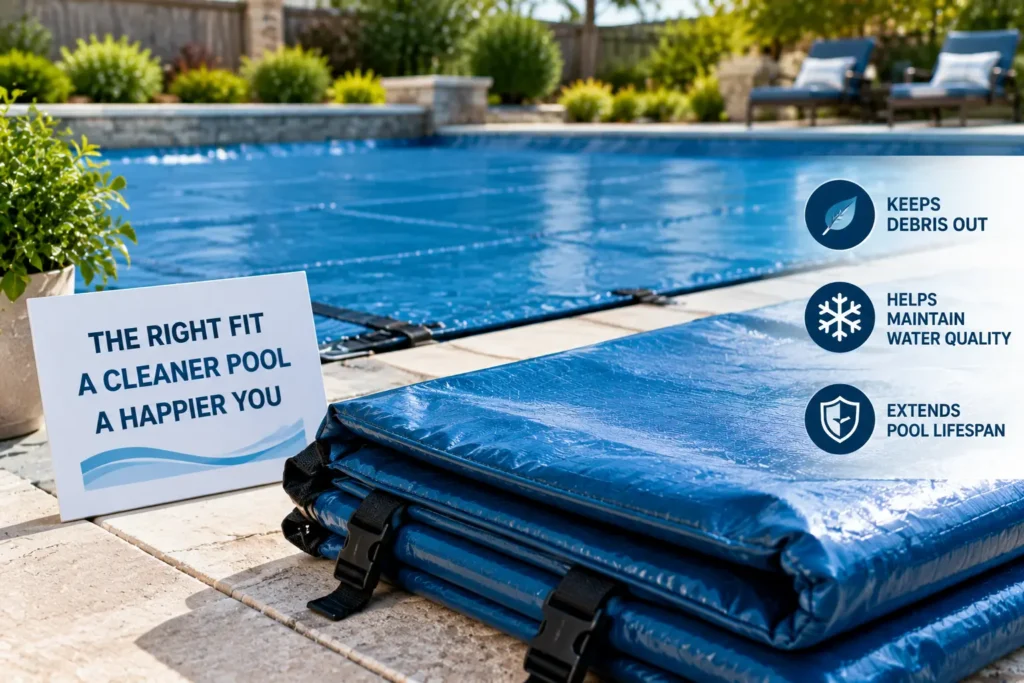
A properly Pool Cover Size Calculator should provide adequate coverage without creating unnecessary excess material.
If the cover is too small, sections of the water may remain uncovered. This can allow leaves, dirt, rainwater, and other debris to enter the pool.
If the cover is significantly oversized, it may be harder to position, fold, store, and secure.
Using a pool cover size calculator before ordering gives you a starting point for determining the dimensions you need.
How to Measure Your Pool
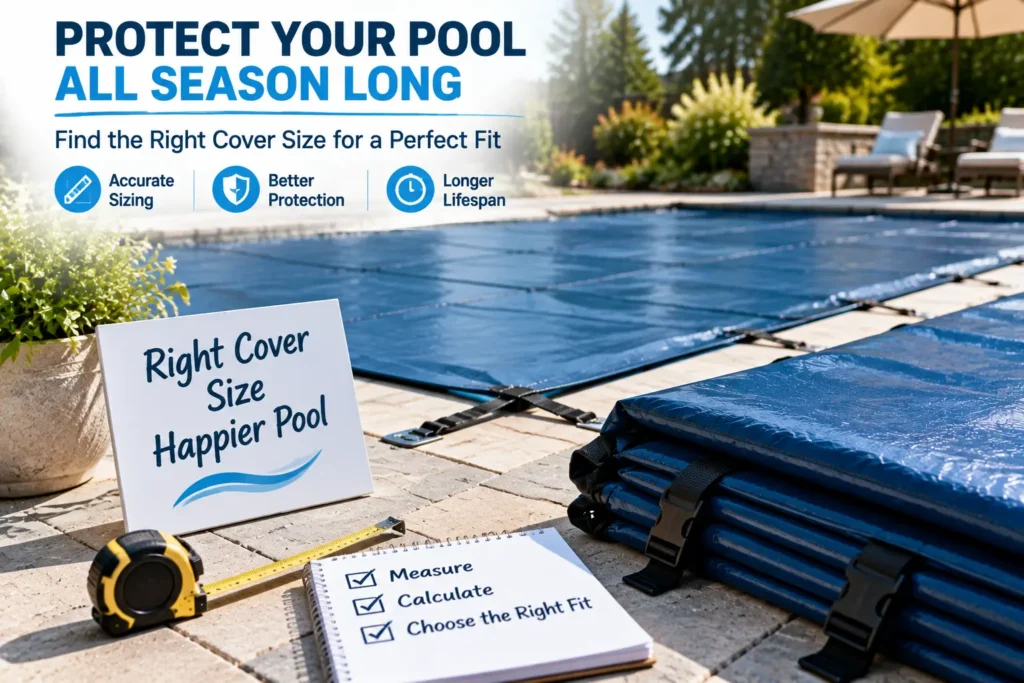
Accurate measurements are the foundation of a good cover-size calculation.
Rectangular Pools
For a rectangular pool, measure:
- The longest length from end to end.
- The widest point from side to side.
- Any additional area that needs to be covered.
- The required overlap based on your cover type.
For example, if your pool is 30 feet long and 15 feet wide, the basic pool footprint is 30 × 15 feet.
The final cover dimensions may need to be larger depending on how the cover is installed.
Oval Pools
Oval pools require length and width measurements as well. Measure the longest point for the length and the widest point for the width.
Because an oval cover extends beyond the pool edge, the final dimensions should account for the manufacturer’s recommended allowance.
Round Pools
For a round pool, measure the diameter across the widest part of the pool.
The cover will generally need to extend beyond the pool’s actual diameter to provide sufficient coverage and allow for proper installation.
Irregular Pools
Freeform and irregular pools can be more difficult to measure.
Take measurements at the longest and widest points and consider the overall outline of the pool. For unusually shaped pools, a custom cover may be more appropriate than relying on a standard rectangular or round size.
Basic Pool Cover Size Formula
A simple calculation can help estimate the required cover dimensions.
For a rectangular pool regarding Pool Cover Size Calculator:
Cover Length = Pool Length + Required Extra Length
Cover Width = Pool Width + Required Extra Width
For example, if a pool measures 30 × 15 feet and you need 2 feet of additional coverage on each side:
Cover Length = 30 + 2 + 2 = 34 feet
Cover Width = 15 + 2 + 2 = 19 feet
The estimated cover size would therefore be 34 × 19 feet.
However, the exact allowance depends on the cover design and installation system. Always check the manufacturer’s requirements before placing an order.
Pool Cover Size Examples
| Pool Shape | Pool Dimensions | Basic Cover Consideration |
| Rectangle | 30 × 15 ft | Add required edge allowance |
| Rectangle | 40 × 20 ft | Add required edge allowance |
| Round | 24 ft diameter | Add required perimeter allowance |
| Oval | 30 × 15 ft | Add required edge allowance |
| Freeform | Custom | Measure widest and longest areas |
These examples show why pool dimensions alone may not always equal the final cover dimensions.
Does Pool Shape Affect Cover Size?
Yes. Pool shape can significantly affect how a cover should be measured.
A rectangular pool usually has straightforward length and width measurements. Round and oval pools require measurements across their widest areas, while freeform pools can require more detailed measurements.
A pool cover size calculator can make the initial calculation easier, but unusual pool shapes may still require a professional measurement or custom cover.
How Much Overlap Should a Pool Cover Have?
The amount of extra material needed around the pool depends on the type of cover.
A winter cover, safety cover, solar cover, and automatic cover can all have different sizing requirements.
For this reason, do not use one universal overlap measurement for every cover. Check the specifications for the particular cover you plan to purchase.
Anchoring systems can also affect the required dimensions. Covers that use straps, springs, anchors, or other attachment methods need enough material for secure installation.
Pool Cover Size and Pool Volume
Pool cover measurements are different from water-volume calculations.
A pool volume calculator estimates how much water your pool contains, while cover sizing focuses on the physical dimensions of the pool surface and the extra coverage needed for installation.
Knowing your pool volume can still be useful when planning other maintenance tasks, but it should not be used as a substitute for measuring the pool itself.
Common Pool Cover Sizing Mistakes
Measuring Only the Water Surface
Do not assume the cover should be exactly the same size as the water surface.
Many covers need additional material beyond the pool edge.
Ignoring the Pool Shape
Using rectangular measurements for a freeform pool can produce an inaccurate estimate.
Forgetting Installation Requirements
Anchors, straps, springs, and other attachment systems may require additional space.
Relying on Guesswork
Even a small measurement error can make a difference when ordering a large cover. Measure carefully and verify the manufacturer’s sizing instructions.
Choosing the Largest Cover Available
Bigger is not automatically better. Excess material can make installation and handling more difficult.
How to Choose the Right Pool Cover
The correct cover depends on more than size.
Consider:
- Pool dimensions
- Pool shape
- Cover purpose
- Local weather
- Safety requirements
- Installation method
- Storage needs
- Manufacturer specifications
If you are preparing the pool for winter, make sure the selected cover is designed for seasonal protection and can be securely installed.
For a complete seasonal preparation routine, your pool closing checklist can help you organize cleaning, water balancing, equipment preparation, and cover installation before closing the pool.
Tips for Accurate Measurements
Before using a pool cover size calculator, measure your pool carefully.
Use a reliable measuring tape and record the dimensions in the same unit. Measure the longest and widest points rather than estimating from memory.
If the pool has steps, attached areas, unusual corners, or a complex shape, note those details separately.
It is also a good idea to measure more than once. Double-checking your numbers can help prevent ordering a cover that does not fit.
Final Thoughts
A pool cover size calculator makes it easier to estimate the cover dimensions needed for your pool. Start with accurate measurements of the pool’s length, width, diameter, or overall shape, then account for the additional material required by your specific cover system.
Remember that different cover types have different sizing requirements. Always compare your calculated dimensions with the manufacturer’s recommendations before buying.
Covering all about Pool Cover Size Calculator, Taking a few extra minutes to measure correctly can help you choose a cover that fits properly, provides better protection, and is easier to install and maintain.