Quick Answer
A spa chemical dosage chart helps hot tub owners understand how much of a particular chemical may be needed to maintain balanced and clean spa water. The correct amount depends on water volume, current test readings, chemical concentration, and the product manufacturer’s instructions. Always test your water before adjusting chemicals and follow the label for the product you are using. In this article, we will cover all about Spa Chemical Dosage Chart.
What Is a Spa Chemical Dosage Chart?
A spa chemical dosage chart provides a convenient reference for common hot tub water treatment products.
Unlike swimming pools, hot tubs typically contain less water but are used at warmer temperatures. This means water chemistry can change relatively quickly, especially when several people use the spa.
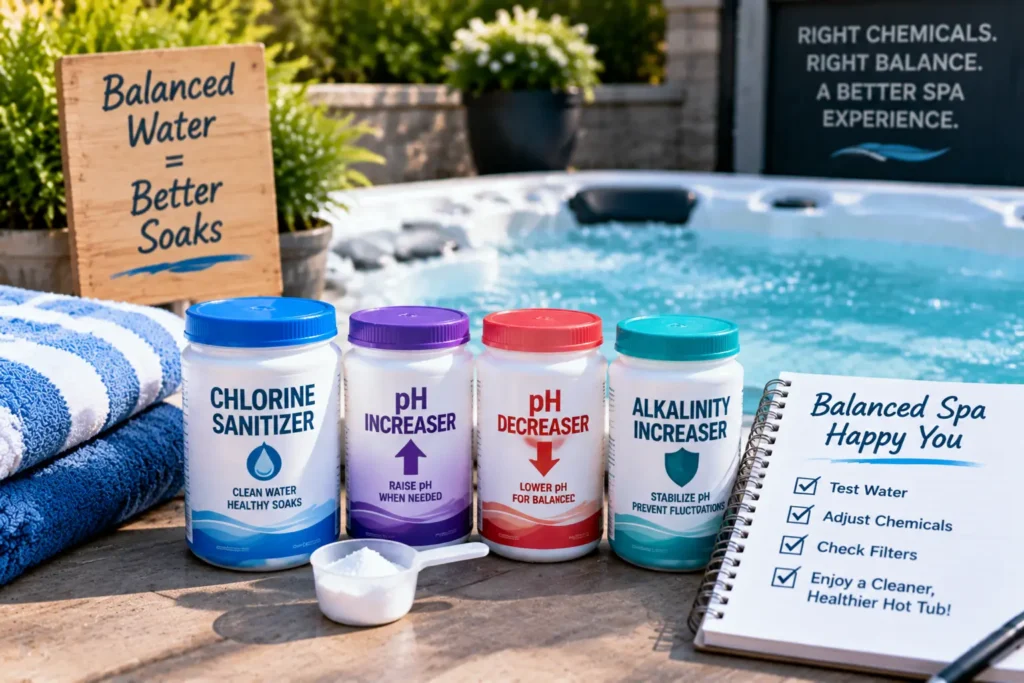
Common chemicals used for spa maintenance include:
- Chlorine
- Bromine
- pH increaser
- pH decreaser
- Alkalinity increaser
- Calcium hardness products
- Spa shock
- Specialty water care products
The exact dosage should always be based on your test results and the instructions provided with your chemical.
Why Is Accurate Chemical Dosage Important?
Using too little chemical may leave the water inadequately sanitized, while adding too much can create unnecessary water chemistry problems.
A spa chemical dosage chart gives you a starting point for understanding treatment amounts, but it should not replace water testing.
Several factors affect the amount of chemical your hot tub needs:
- Spa water volume
- Current chemical level
- Target level
- Product strength
- Frequency of use
- Number of bathers
- Water temperature
- Frequency of water replacement
Because every spa is different, avoid blindly applying the same amount every time.
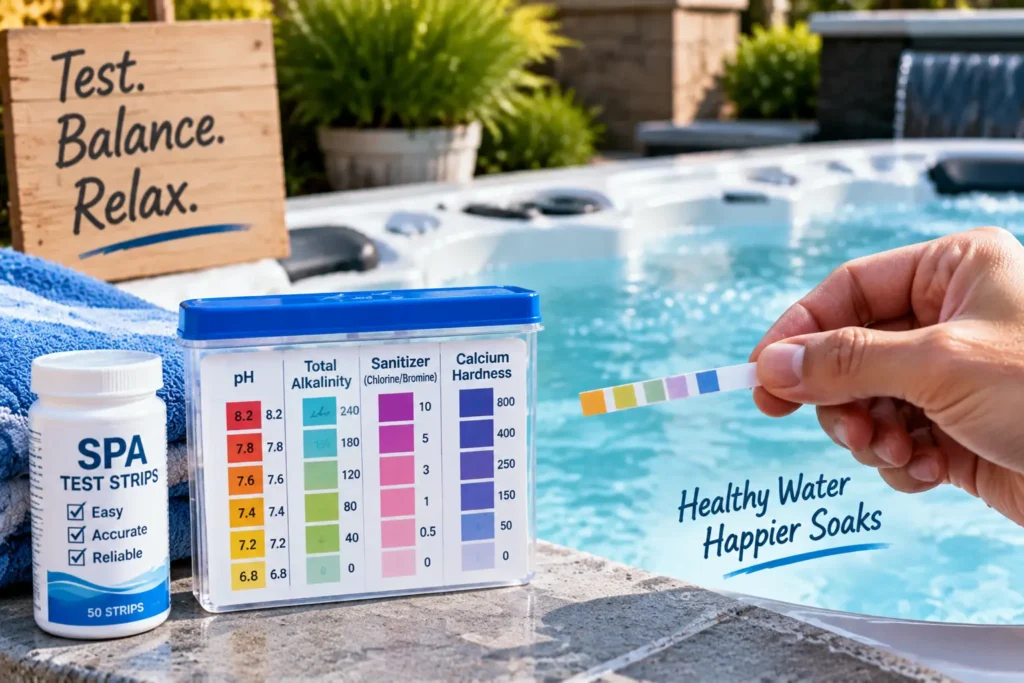
Common Hot Tub Chemical Dosages
The following table provides general examples of common chemical categories. These are illustrative ranges, not universal dosing instructions.
| Chemical | Main Purpose | Typical Use |
| Chlorine | Sanitization | Adjust according to test reading |
| Bromine | Sanitization | Maintain the recommended range |
| pH increaser | Raises pH | Add gradually and retest |
| pH decreaser | Lowers pH | Add gradually and retest |
| Alkalinity increaser | Raises alkalinity | Dose according to water volume |
| Spa shock | Oxidizes contaminants | Follow product label |
| Calcium hardness increaser | Raises hardness | Calculate based on test results |
Always check the product label because concentrations and recommended doses can vary significantly between products.
How to Calculate Spa Chemical Dosage
The basic concept is simple:
Chemical Needed = Water Volume × Required Dose
However, the actual calculation depends on how the chemical manufacturer defines its dosage.
For example, a product might specify a certain amount per 100 gallons of water. If your spa holds 400 gallons, you would multiply the recommended dose by four.
Before making the calculation, confirm:
- Your actual spa volume
- Your current test reading
- Your desired target
- The product concentration
- The manufacturer’s recommended dose
This approach helps prevent unnecessary chemical use.
Determine Your Spa Water Volume First
Accurate water volume is essential for chemical calculations.
If you do not know your spa’s capacity, a spa volume calculator can help estimate the amount of water it holds using measurements such as length, width, depth, and shape.
Many manufacturers also provide the approximate water capacity in the spa’s specifications or owner’s manual.
Remember that the actual amount of water can differ from the maximum advertised capacity because of the number of people in the spa, water level, and internal components.
Chlorine and Bromine Dosage
Chlorine and bromine are commonly used to sanitize spa water.
Chlorine
Chlorine helps control microorganisms and contaminants introduced into the water.
The amount required depends on the current sanitizer reading, desired level, spa volume, and chemical concentration. Test the water before adding chlorine and allow it to circulate before testing again.
Bromine
Bromine is another popular sanitizer for hot tubs. It is often used because it performs well in warm water.
As with chlorine, dosing should be based on water testing and the specific product instructions rather than a fixed amount for every spa.
A spa chemical dosage chart can help organize these treatment categories, but the manufacturer’s directions should always take priority.
Adjusting Hot Tub pH
Proper pH is important for comfortable water and effective sanitizer performance.
If the pH is too low, the water may become more corrosive. If it is too high, scaling and cloudy water can become concerns.
Test the water before making an adjustment.
If the pH needs to be raised, use the appropriate pH increaser. If it needs to be lowered, use a suitable pH decreaser.
Add small amounts when appropriate, allow the water to circulate, and retest before making another adjustment.
Adjusting Total Alkalinity
Total alkalinity helps stabilize pH and can make water chemistry easier to manage.
If alkalinity is below the recommended range, an alkalinity increaser may be needed. If it is too high, the correction should be made carefully according to your testing results and product instructions.
Do not make several major chemical adjustments at the same time without allowing the water to circulate and retesting.
When Should You Add Spa Shock?
Spa shock is generally used to help oxidize contaminants and refresh the water after heavy use.
You may consider shock treatment after:
- Heavy bather use
- A period of poor water quality
- Certain sanitizer maintenance routines
- Following the instructions for your particular water care system
Always read the product label before using shock because different products have different application instructions.
Example Chemical Calculation
Suppose your spa contains 400 gallons of water and a product recommends a specific dose per 100 gallons.
If the recommended dose is one unit per 100 gallons:
400 ÷ 100 = 4
You would therefore multiply the manufacturer’s stated dose by four.
This example demonstrates the calculation method rather than recommending a specific chemical amount. Always use the actual dosage printed on your product.
Common Chemical Dosing Mistakes
Adding Chemicals Without Testing
Guessing your water chemistry can result in unnecessary treatment.
Using Pool Dosages for a Spa
Hot tubs have different water volumes and operating conditions. Do not automatically use pool chemical instructions for spa water.
Adding Too Much at Once
Large chemical additions can create sudden changes in water chemistry. Follow the product directions and allow adequate circulation.
Ignoring Product Concentration
Two products with the same purpose may have different strengths. Always check the label.
Not Retesting
After adjusting the water, retest according to the product instructions to confirm the result.
Simple Spa Chemical Maintenance Routine
A consistent routine makes chemical management easier.
Before use:
- Check the water condition.
- Test sanitizer and pH when needed.
After heavy use:
- Test the sanitizer.
- Adjust chemicals if necessary.
- Consider shock treatment according to your water care system.
Weekly:
- Test major water chemistry levels.
- Inspect and clean the filter as needed.
- Check the water level.
Periodically:
- Drain and refill according to your maintenance routine.
- Deep clean the spa.
- Inspect equipment and components.
A spa chemical dosage chart can be kept with your water testing supplies as a quick reference, while actual dosing should always be based on your test results and product instructions.
Final Thoughts
A spa chemical dosage chart is useful for understanding the different chemicals involved in hot tub maintenance and how dosing calculations work. However, there is no single chemical amount that works for every spa.
Understanding all about Spa Chemical Dosage Chart , Start with accurate water volume, test your current chemistry, identify the desired adjustment, and follow the manufacturer’s dosage instructions. Adding chemicals gradually and retesting the water can help you maintain cleaner, more comfortable spa water while avoiding unnecessary chemical use.