Quick Answer
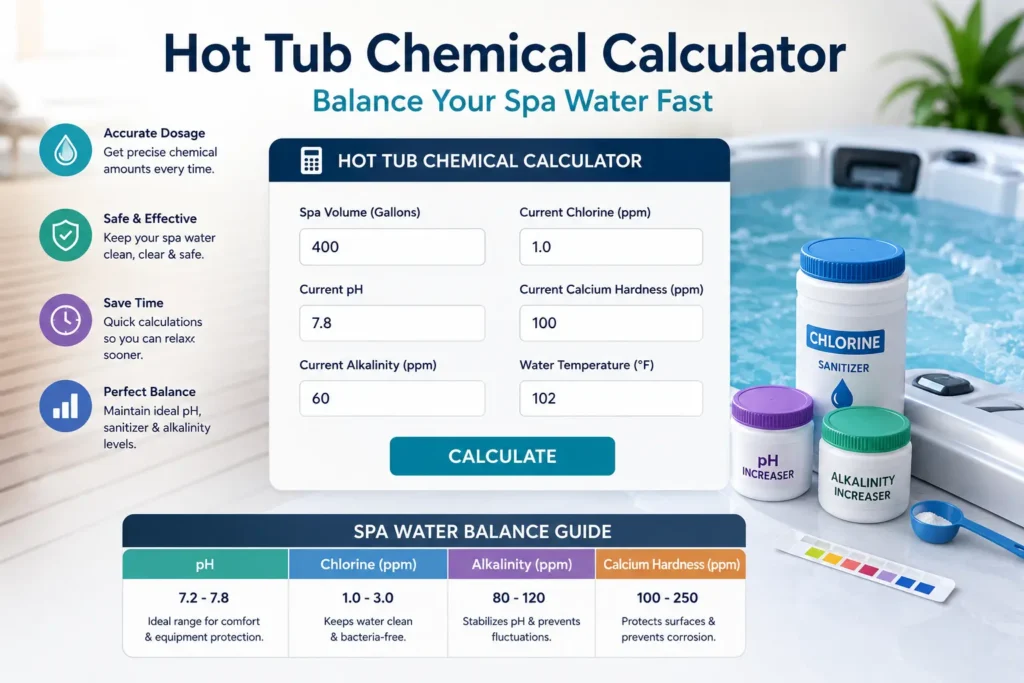
A hot tub chemical calculator helps you estimate how much of a chemical may be needed to adjust your spa water. By entering details such as water volume, current chemical level, and desired level, you can get a more practical starting point for treatment.
Because hot tubs hold less water than most swimming pools, chemical levels can change quickly. Regular testing and careful dosing are essential for maintaining comfortable and properly balanced water.
Why Chemical Balance Matters in a Hot Tub
Hot tub water requires regular attention because warm water, frequent use, and a smaller water volume can cause chemical levels to change quickly.
Poorly balanced water can lead to cloudy water, unpleasant odors, scale formation, or irritation. On the other hand, adding too much chemical can create its own problems.
A hot tub chemical calculator can make dosing easier by giving you an estimate based on your actual water volume and test results.
However, calculator results should always be compared with the instructions on your chemical product and the recommendations for your specific spa.
What Information Do You Need?
Before calculating a chemical dose, collect a few basic measurements.
You will generally need:
- Hot tub water volume
- Current chemical reading
- Desired chemical level
- Chemical product concentration
- Type of chemical being used
Accurate measurements produce more useful results. If you are unsure about your hot tub’s capacity, check the manufacturer’s specifications or calculate the approximate volume from its dimensions.
Chlorine Calculations for Hot Tubs
Chlorine is commonly used to sanitize hot tub water and control microorganisms. The amount required depends on the current chlorine level, target level, water volume, and strength of the product.
A hot tub chemical calculator can help estimate the amount needed to move from a measured chlorine level toward your target.
Using a Hot Tub Chlorine Calculator
A hot tub chlorine calculator is useful when you need to estimate a chlorine dose after testing the water.
For example, if testing shows that the sanitizer level is below the recommended range, you can enter the current reading and water volume to estimate the required adjustment.
Always check the product label before adding chlorine because different products have different concentrations and dosing instructions.
Adjusting Hot Tub pH
pH affects water comfort, sanitizer performance, and the condition of spa equipment.
If pH is too low, the water can become more corrosive. If it is too high, scale and cloudy water may become more likely.
A hot tub chemical calculator can help you estimate an adjustment, but pH calculations are not always perfectly predictable because alkalinity and other water chemistry factors can influence the result.
Using a Hot Tub pH Calculator
A hot tub ph calculator can provide an estimate of how much pH adjustment product may be required.
Test the water first, make a calculated adjustment, allow the water to circulate, and then test again. Avoid adding large amounts at once without checking the results.
Alkalinity and pH Work Together
Total alkalinity helps stabilize pH and can affect how easily pH changes over time.
If alkalinity is significantly outside the recommended range, correcting it may be necessary before making repeated pH adjustments.
This is why chemical calculations should not be treated as isolated numbers. Your sanitizer, pH, alkalinity, and other measurements work together as part of the overall water chemistry.
How to Use a Hot Tub Chemical Calculator
The basic process is straightforward.
Step 1: Test the Water
Use a reliable test kit or test strips to measure the current sanitizer, pH, and alkalinity levels.
Step 2: Confirm Water Volume
Enter the actual hot tub capacity. An incorrect volume can result in an incorrect chemical estimate.
Step 3: Enter Current and Target Levels
Provide the current reading and the desired level required by your spa system or chemical instructions.
Step 4: Select the Chemical
Different products have different strengths. Make sure the calculation matches the product you are actually using.
Step 5: Add the Chemical Carefully
Follow the product label and add the recommended amount gradually when appropriate.
Step 6: Test Again
Allow the water to circulate before retesting. If the reading is still outside the desired range, make another small adjustment rather than adding a large amount immediately.
Common Hot Tub Chemical Mistakes
Even with accurate calculations, certain habits can cause water chemistry problems.
Adding chemicals without testing: Guessing often leads to unnecessary chemical use.
Using the wrong product concentration: Two products with the same purpose may have different strengths.
Ignoring alkalinity: Persistent pH problems can sometimes be related to alkalinity.
Adding too much at once: Large adjustments can overshoot the desired level.
Not allowing circulation time: Testing immediately after adding chemicals may not represent the fully mixed water.
Forgetting water replacement: Hot tubs eventually need fresh water because dissolved substances and contaminants can accumulate.
How Often Should You Test Hot Tub Water?
Testing frequency depends on how often the hot tub is used.
A frequently used spa may require more frequent testing than one that is used occasionally. Testing is especially important after heavy use, significant water replacement, or chemical adjustments.
Keep a simple record of your test results. Tracking pH, sanitizer, and alkalinity can help you identify patterns and understand how quickly your water chemistry changes.
Can a Calculator Replace Water Testing?
No. A calculator works from the information you provide, so it cannot replace an actual water test.
If your starting measurement is inaccurate, the calculated dose may also be inaccurate. Testing should always come first.
The best approach is to use calculations as a dosing aid while relying on actual test results to confirm the water condition.
Tips for More Accurate Chemical Dosing
Use these habits to get better results:
- Measure the water volume as accurately as possible.
- Check chemical concentrations on product labels.
- Test water before making adjustments.
- Make gradual corrections.
- Allow enough circulation time.
- Retest after treatment.
- Follow manufacturer instructions.
- Keep chemicals stored safely and separately.
A hot tub chemical calculator is most useful when combined with consistent testing and careful dosing rather than used as a replacement for good maintenance practices.
Frequently Asked Questions
What does a hot tub chemical calculator calculate?
It can estimate chemical adjustments based on factors such as water volume, current readings, target levels, and product strength.
Can I use the calculator for chlorine?
Yes. Chlorine dosing can be estimated when you know the hot tub volume, current sanitizer level, desired level, and product concentration.
How do I know if my hot tub needs chemicals?
Testing the water is the best way to determine whether sanitizer, pH, alkalinity, or another chemical needs adjustment.
Should I add chemicals before testing?
It is generally better to test first so you know what actually needs correction. Adding chemicals without knowing the current level can result in overdosing.
Why does hot tub chemistry change so quickly?
Warm water, frequent use, aeration, and the relatively small water volume can cause sanitizer and pH levels to change more quickly than many pool owners expect.
Conclusion
A hot tub chemical calculator provides a convenient way to estimate chemical adjustments based on your spa’s water volume and test results. It can make dosing more straightforward while helping you avoid unnecessary guesswork.
For the best results, always test your water first, use the correct product information, make gradual adjustments, and retest after circulation. Consistent testing combined with careful calculations is the key to maintaining clean, comfortable, and properly balanced hot tub water.