Quick Answer
A Weekly Pool Chemical Checklist gives you a simple routine for checking the most important pool water chemistry levels. Test chlorine, pH, alkalinity, and other levels relevant to your pool system before adding chemicals. Regular testing helps identify problems early and prevents unnecessary chemical adjustments.
Why Weekly Pool Chemical Checklist Maintenance Matters
Pool chemistry can change because of swimmers, sunlight, rainfall, evaporation, fresh water, and chemical use. Clear looking water does not always mean the chemistry is balanced.
Following a Weekly Pool Chemical Checklist helps you create a consistent maintenance routine instead of waiting for cloudy water, algae, unusual odors, or swimmer discomfort.
The goal is not to add every chemical every week. Instead, test the water, identify what needs attention, make the necessary adjustment, and retest.
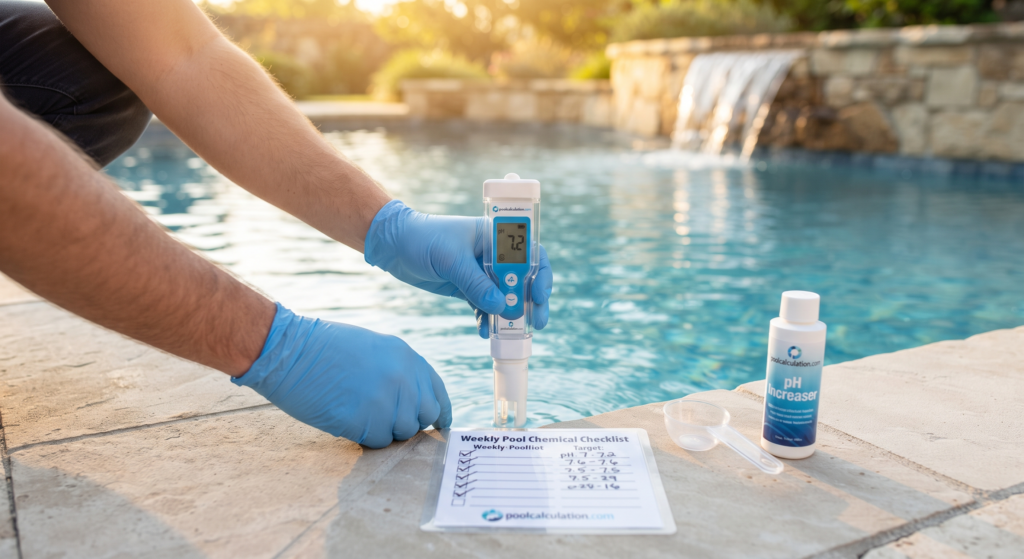
Weekly Pool Chemical Checklist
The Weekly Pool Chemical Checklist below covers the main areas worth checking during routine maintenance.
| Check | What to Test | Why It Matters |
|---|---|---|
| Free chlorine | Sanitizer level | Helps maintain clean water |
| pH | Current pH | Supports chlorine performance and comfort |
| Total alkalinity | Alkalinity level | Helps stabilize pH |
| CYA | Stabilizer level | Protects chlorine from sunlight |
| Calcium hardness | Calcium level | Supports water balance |
| Salt | Salt concentration | Important for saltwater systems |
| Water appearance | Clarity and color | Helps identify developing issues |
| Equipment | Pump and filtration | Supports circulation |
Not every reading needs to be adjusted every week. Testing tells you what actually needs attention.
Step 1: Test Free Chlorine
Free chlorine shows how much available sanitizer is present in the pool.
The appropriate level depends on your pool type, stabilizer level, sanitizer system, and maintenance approach.
If chlorine is low, consider possible causes before simply adding more. Heavy swimmer use, sunlight, algae, contamination, or low stabilizer can increase chlorine demand.
If the pool is green or heavily contaminated, routine weekly maintenance may not be enough and a separate treatment may be required.
Step 2: Check pH
pH is another important weekly reading. A commonly used range for many residential pools is 7.2 to 7.8.
If pH is too low, use an appropriate pH increaser according to the product instructions. If it is too high, use a suitable pH reducer.
Make gradual adjustments and allow the water to circulate before testing again.
Step 3: Test Total Alkalinity
Total alkalinity helps buffer the water against rapid pH changes.
Low alkalinity can make pH fluctuate, while high alkalinity can make pH more difficult to lower.
Include alkalinity in your Weekly Pool Chemical Checklist, especially if your pH repeatedly moves outside the desired range.
If an adjustment is needed, use your pool volume and the product instructions to determine the appropriate amount.
Step 4: Check CYA or Stabilizer
Cyanuric acid, commonly called CYA or stabilizer, helps protect chlorine from ultraviolet sunlight.
CYA does not usually require adjustment every week, but it should be checked periodically. This is especially important if stabilized chlorine products are used regularly.
Low CYA can contribute to faster chlorine loss in sunlight, while excessive CYA can make chlorine management more difficult.
Test before adding stabilizer rather than assuming it is needed.
Step 5: Check Calcium Hardness
Calcium hardness is another part of overall pool water balance.
Very low or high calcium levels can contribute to different water chemistry problems. The appropriate target depends on factors such as the pool surface and water management system.
It generally does not need adjustment every week, but periodic testing should be included in your broader maintenance routine.
Step 6: Check Salt in Saltwater Pools
Saltwater chlorine generators require an appropriate salt concentration to operate properly.
If you’re following a saltwater pool maintenance checklist, compare the salt reading with the operating range recommended for your specific generator.
Do not add salt without testing first. Rainfall, water replacement, and dilution can change the concentration.
Understanding Pool Salt Levels
Your pool salt levels should be compared with the manufacturer’s recommended operating range.
If the reading is below the required range, calculate the amount needed based on your pool volume and the required increase. If it is already within range, adding more salt is unnecessary.
Step 7: Inspect Water and Equipment
Chemical testing should be combined with a quick physical inspection.
Look for:
- Cloudy water
- Green coloration
- Excessive debris
- Surface buildup
- Unusual odors
- Poor circulation
Also check the skimmer, pump, filter, and circulation system. Poor circulation can prevent chemicals from distributing properly throughout the pool.
Keep a Weekly Record
A Weekly Pool Chemical Checklist becomes more useful when you record your results.
Example readings below are for reference only. Actual targets may vary depending on your pool type, sanitizer system, and manufacturer recommendations.
| Reading | Current Result | Target | Action |
|---|---|---|---|
| Free chlorine | 2 ppm | Pool specific | Maintain if in range |
| pH | 7.5 | 7.2 to 7.8 commonly used | No adjustment needed |
| Alkalinity | 90 ppm | Pool specific | Maintain if in range |
| CYA | 40 ppm | Pool specific | Maintain if in range |
| Calcium hardness | 250 ppm | Pool specific | Maintain if in range |
| Salt | 3,200 ppm | Generator specific | Maintain if in range |
Keeping records helps you recognize patterns. For example, if pH rises every week, you can investigate the cause instead of repeatedly adding pH reducer.
Common Chemical Mistakes
A Weekly Pool Chemical Checklist should help prevent unnecessary chemical adjustments.
Avoid these mistakes in Weekly Pool Chemical Checklist:
- Adding chemicals without testing
- Guessing pool volume
- Using a fixed dose for every pool
- Ignoring product concentration
- Adjusting several chemicals at once
- Failing to circulate before retesting
- Adding salt without checking the current level
Always follow the product label when measuring and applying chemicals.
Pool Chemical Safety
Read the manufacturer’s instructions before using any pool chemical. Follow the recommended procedures for measuring, handling, application, and storage.
Never mix pool chemicals unless the manufacturer specifically confirms they are compatible. Keep chemicals in their original containers and store them safely away from children and pets.
After making an adjustment, allow adequate circulation and follow the product instructions before swimming.
Frequently Asked Questions
Do I need to test every chemical every week?
Not necessarily. Chlorine and pH usually need more frequent attention, while CYA, calcium hardness, and salt can be checked according to your pool and system requirements.
Should I add chemicals every week?
No. Test the water first and only adjust chemicals when the readings show that an adjustment is needed.
What should I check first?
Start with chlorine and pH, then check alkalinity and other chemistry levels relevant to your pool system.
How often should saltwater pools be tested?
Follow the recommendations for your saltwater chlorine generator and test whenever you suspect dilution or a change in salt concentration.
Should I record my pool test results?
Yes. Keeping a record makes it easier to identify recurring problems and understand how your pool chemistry changes over time.
Conclusion
A Weekly Pool Chemical Checklist provides a simple routine for monitoring the most important parts of pool water chemistry. Test chlorine, pH, alkalinity, stabilizer, calcium hardness, and salt when applicable before deciding whether an adjustment is necessary.
Keep accurate records, make gradual corrections, follow product instructions, and retest after treatment. A consistent weekly routine can reduce guesswork and make maintaining balanced pool water much easier.