Quick Answer
Common Pool Chemical Mistakes usually happen when pool owners add chemicals without testing, use incorrect doses, ignore product instructions, or try to fix several water problems at once. Other problems include poor chemical storage, incorrect salt measurements, and failing to retest after an adjustment. Testing first, calculating doses carefully, and following product directions can make pool maintenance safer and more predictable.
Why Pool Chemical Mistakes Happen
Pool chemistry can seem complicated because several water parameters work together. A change in one reading can affect another, which is why adding chemicals based on guesswork can create additional problems.
Understanding Common Pool Chemical Mistakes helps you avoid unnecessary adjustments and maintain a more consistent maintenance routine.
The most important rule is simple: test the water before deciding what to add.
1. Adding Chemicals Without Testing
One of the most frequent mistakes is adding chemicals simply because it is part of a weekly routine.
For example, adding chlorine when the chlorine level is already high can create an unnecessary imbalance. The same applies to pH increaser, pH reducer, stabilizer, or salt.
Instead:
- Test the water.
- Record the current reading.
- Identify the target.
- Calculate the required adjustment.
- Add the appropriate product according to its instructions.
- Retest after circulation.
This approach reduces guesswork.
2. Using the Wrong Chemical Amount
Another example of Common Pool Chemical Mistakes is assuming that one fixed dose works for every pool.
Chemical requirements depend on:
- Pool volume
- Current chemical level
- Desired target
- Product concentration
- Pool type
- Water conditions
A 5,000-gallon pool will not require the same amount as a 20,000-gallon pool for the same chemical adjustment.
Always calculate the amount based on your actual pool rather than copying a dose from another pool.
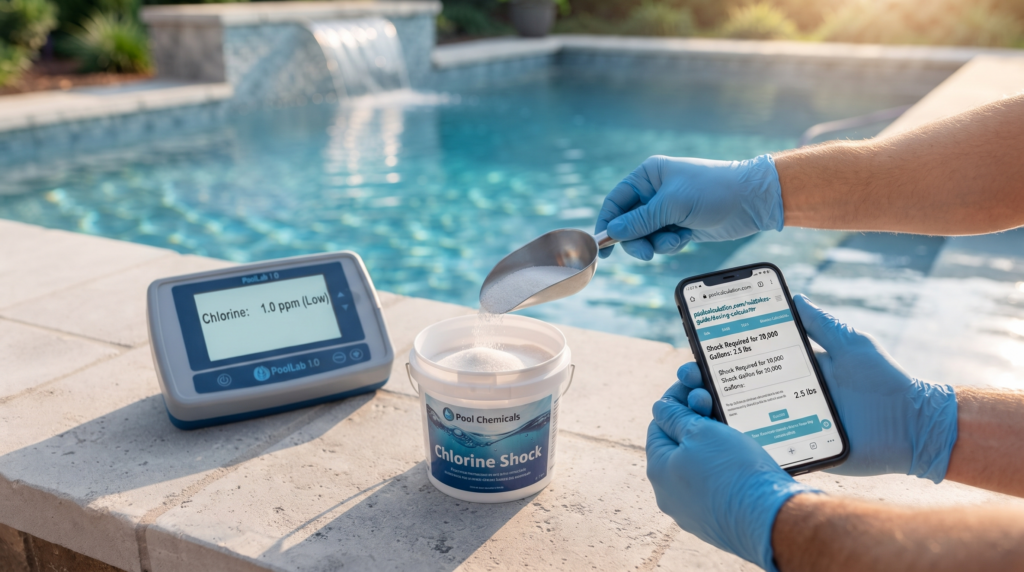
3. Ignoring Product Strength
Two products designed for the same purpose may contain different concentrations.
This is particularly important with chlorine and shock products. The amount listed for one product cannot automatically be applied to another product with a different strength.
Read the label carefully and use the manufacturer’s dosage instructions along with your water test results.
4. Trying to Fix Everything at Once
When several readings are outside the desired range, it can be tempting to add multiple chemicals immediately.
This can make it difficult to understand how each adjustment affected the water.
A better approach is to prioritize the chemistry that needs attention, make the appropriate adjustment, allow circulation, and then retest before continuing.
5. Ignoring Pool Salinity
Saltwater pools require additional attention because their chlorine generators depend on an appropriate salt concentration.
Pool salinity should be measured with a method designed for salt concentration. Do not assume the level is correct based only on the appearance of the water.
Rain, water replacement, splash-out, and dilution can affect salt concentration.
6. Adding Salt Without Checking Salt Levels
One of the more costly Common Pool Chemical Mistakes is adding salt without first measuring the existing concentration.
The correct salt levels for pool water depend on the specific saltwater chlorine generator. Different systems can have different recommended operating ranges.
Before adding salt, check:
- Current salt concentration
- Pool volume
- Manufacturer’s recommended level
- Amount of salt already added
- Recent water replacement or dilution
If the salt level is already within the recommended range, additional salt is unnecessary.
7. Confusing Salt With Chlorine
Saltwater pools still use chlorine. The saltwater generator converts dissolved salt into chlorine as part of its sanitizing process.
This is why understanding pool chlorine salt systems is important. A saltwater pool is not a chlorine-free pool; it uses a different method to generate chlorine.
You should continue monitoring chlorine and other important chemistry levels according to your pool system’s requirements.
8. Neglecting pH and Alkalinity
Another common problem is focusing only on chlorine while ignoring pH and alkalinity.
pH affects swimmer comfort and chlorine performance. Total alkalinity helps stabilize pH.
A commonly used pH range for many residential pools is around 7.2 to 7.8, although the appropriate targets can vary according to the pool and maintenance system.
Test both readings and make adjustments based on actual results rather than appearance.
9. Not Retesting After Chemical Adjustments
Failing to retest is another example of Common Pool Chemical Mistakes.
After adding a chemical, allow the water to circulate according to the product instructions. Then test the affected parameter again.
Retesting helps you determine whether the adjustment was sufficient or whether another correction is necessary.
Chemical Mistakes at a Glance
| Mistake | Possible Problem | Better Approach |
| Adding without testing | Unnecessary chemical adjustment | Test first |
| Using a fixed dose | Incorrect concentration | Calculate by pool volume |
| Ignoring product strength | Over or under dosing | Read the label |
| Adding several chemicals together | Difficult to track changes | Adjust systematically |
| Adding salt without testing | Excessive salt concentration | Check salt first |
| Ignoring pH | Poor water balance | Test regularly |
| Skipping retesting | Unknown final result | Test after circulation |
| Poor storage | Safety and product issues | Follow storage instructions |
How to Avoid Chemical Problems
The easiest way to prevent Common Pool Chemical Mistakes is to create a simple testing routine.
Test Before Dosing
Never rely entirely on a schedule. Let your water test determine whether an adjustment is necessary.
Know Your Pool Volume
An accurate volume estimate is essential for chemical calculations.
Keep a Record
Write down your test results and chemical additions. This can help identify recurring patterns.
Follow Product Instructions
Different chemicals have different concentrations, application methods, and safety requirements.
Make Gradual Adjustments
Avoid adding excessive amounts because the water does not change immediately. Allow circulation and retest according to the product directions.
Pool Chemical Safety
Pool chemicals should always be handled carefully. Read the product label before use and follow instructions for measuring, application, storage, and disposal.
Never mix pool chemicals together unless the manufacturer specifically confirms that they are compatible.
Keep chemicals in their original containers and store them in an appropriate location away from children and pets.
Frequently Asked Questions
What is the biggest pool chemical mistake?
Adding chemicals without testing is one of the biggest mistakes because it can result in unnecessary or excessive chemical adjustments.
Can I use the same chemical dose for every pool?
No. Pool volume, current chemistry, target level, and product concentration all affect the required amount.
Do saltwater pools still need chlorine?
Yes. Saltwater chlorine generators produce chlorine from dissolved salt, so chlorine levels still need to be monitored.
Conclusion
Avoiding Common Pool Chemical Mistakes starts with one simple habit: test before you treat. Accurate testing, correct dosage calculations, proper salt monitoring, and careful chemical handling can make pool maintenance much easier.