Quick Answer
A pool stabilizer level guide helps you understand cyanuric acid, commonly called CYA, and why it matters for outdoor pools. Stabilizer protects chlorine from being broken down too quickly by sunlight. If CYA is too low, chlorine can disappear rapidly. If it is too high, chlorine can become less effective for sanitation. Test CYA regularly and adjust it carefully according to your pool’s needs.
What Is Pool Stabilizer Level Guide?
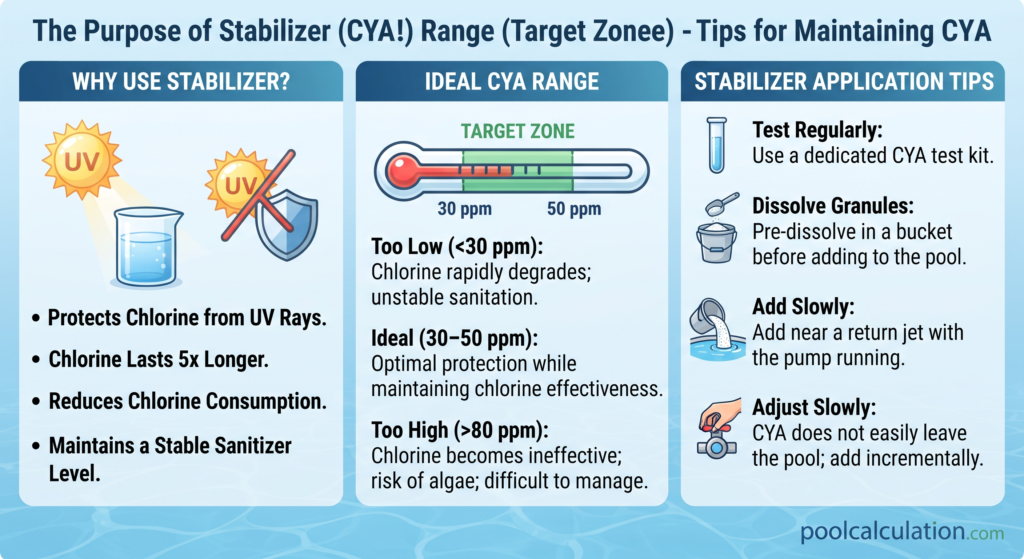
Pool stabilizer is the common name for cyanuric acid (CYA). It is used mainly in outdoor pools to protect chlorine from ultraviolet sunlight.
Without enough stabilizer, sunlight can break down chlorine quickly, which can make it harder to maintain an effective sanitizer level. CYA helps reduce this loss and allows chlorine to remain available in the water for longer.
However, adding more stabilizer is not always better. Excessive CYA can change the way chlorine behaves and may make maintaining proper sanitation more difficult.
This pool stabilizer level guide explains the appropriate range, how to test CYA, how dosage calculations work, and the mistakes that can cause stabilizer levels to become unbalanced.
What Is the Ideal CYA Range?
The appropriate CYA level depends on the type of pool, sanitizer system, and overall chlorine-management approach. For many outdoor residential pools using chlorine, a commonly used range is around 30 to 50 ppm.
| CYA Level | General Condition | What It Means |
| Very low | Limited UV protection | Chlorine can be lost quickly |
| Around 30–50 ppm | Common operating range | Provides useful chlorine protection |
| High | Excess stabilizer | Chlorine management can become more difficult |
| Very high | Potentially problematic | May require corrective action |
These values are general guidance. Always consider the recommendations for your specific pool and sanitation system.
Why Does Pool Stabilizer Level Guide Matter?
CYA plays an important role in outdoor pool chemistry because it interacts with chlorine.
Protects Chlorine From Sunlight
Ultraviolet sunlight can break down unstabilized chlorine. CYA helps protect chlorine from this process.
Helps Maintain Chlorine
With an appropriate CYA level, chlorine can remain available in the water for longer instead of being rapidly consumed by sunlight.
Too Much Can Cause Problems
CYA does not simply provide benefits indefinitely. As the level increases, chlorine management changes. Very high stabilizer can make it harder to maintain effective sanitation.
For this reason, testing before adding more stabilizer is important.
How to Test CYA
Before adjusting stabilizer, test the existing CYA level.
CYA can be measured using suitable pool test strips or a liquid testing method. The testing method should be used according to its instructions because inaccurate testing can lead to unnecessary chemical additions.
A basic testing process is:
- Collect a representative water sample.
- Follow the instructions for your test method.
- Record the CYA reading.
- Compare it with your desired range.
- Determine whether an adjustment is actually needed.
Do not add stabilizer simply because the pool has been losing chlorine. Low chlorine can have several causes, and CYA should be confirmed before making an adjustment.
Using a Pool Stabilizer Calculator
A pool stabilizer calculator can estimate how much cyanuric acid may be required to increase CYA from its current level to a desired target.
The calculation of Pool Stabilizer Level Guide generally depends on:
- Pool volume
- Current CYA
- Target CYA
- Stabilizer product concentration
For example, a pool with 10,000 gallons of water and a CYA level of 10 ppm will require a different amount than a 20,000-gallon pool with the same starting level.
The calculator makes the dosage math easier, but the final amount should always be checked against the product label.
CYA Dosage Example
The amount of stabilizer required depends on the size of the pool and the increase needed.
| Pool Information | Example |
| Pool volume | 10,000 gallons |
| Current CYA | 20 ppm |
| Desired CYA | 40 ppm |
| Required increase | 20 ppm |
| Product | Check manufacturer’s concentration |
The example demonstrates the calculation concept rather than providing a universal product dosage. Different stabilizer products can have different instructions, so the package directions should be used for the final amount.
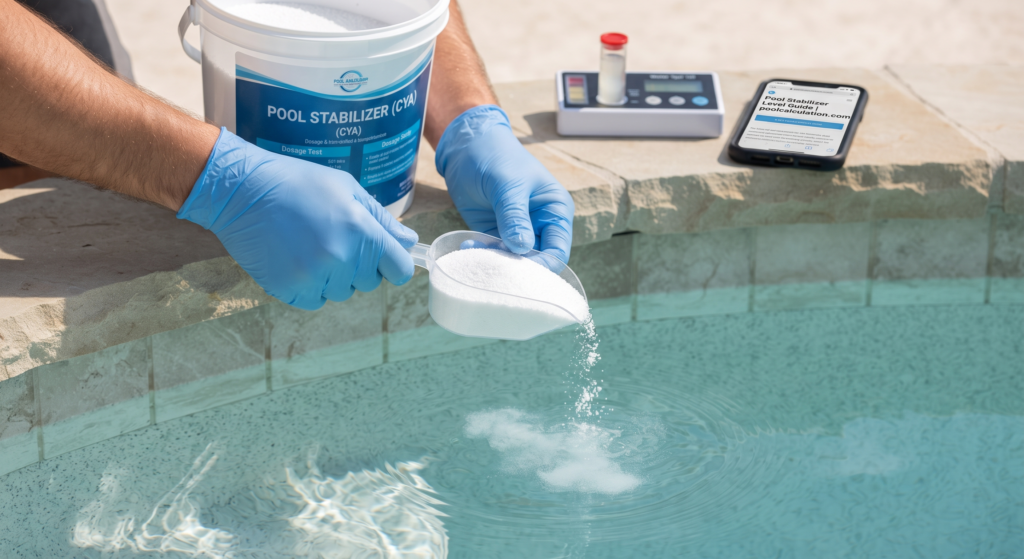
How to Add Pool Stabilizer
Once testing confirms that CYA needs to be increased, follow the product instructions carefully.
A general process is:
- Confirm the current CYA level.
- Determine the desired target.
- Calculate the required amount.
- Measure the product accurately.
- Apply it according to the manufacturer’s instructions.
- Allow adequate circulation.
- Wait for the recommended period before retesting.
Do not repeatedly add stabilizer just because the test result does not change immediately. Some products take time to dissolve and register accurately on a test.
What Happens When CYA Is Too Low?
Low CYA means the pool has less protection against sunlight-driven chlorine loss.
You may notice that chlorine levels drop quickly, especially during sunny weather. This can increase chlorine demand and make maintaining the desired sanitizer level more difficult.
If testing confirms low CYA, adjust it gradually according to the appropriate target and product instructions.
What Happens When CYA Is Too High?
High CYA can make chlorine management more complicated. The relationship between CYA and chlorine means that simply adding more chlorine may not solve the underlying issue when stabilizer has accumulated excessively.
If your CYA is significantly above the desired range, avoid adding additional stabilizer. Instead, review your pool’s overall chemistry and determine the appropriate corrective approach.
CYA and Chlorine Relationship
The cya calculator can help with stabilizer calculations, but CYA should not be considered separately from chlorine.
| CYA Condition | Chlorine Consideration |
| Low CYA | Chlorine may be lost faster to sunlight |
| Appropriate CYA | Better UV protection |
| High CYA | Chlorine management may become more demanding |
The exact chlorine target should be based on your pool’s CYA level and sanitation method rather than using one fixed chlorine number for every pool.
Common Pool Stabilizer Mistakes
The most common mistakes about Pool Stabilizer Level Guide include:
- Adding CYA without testing first
- Guessing pool volume
- Adding too much stabilizer
- Assuming all stabilizer products have identical dosages
- Retesting too soon
- Confusing CYA with chlorine
- Adding more CYA when the existing level is already high
- Ignoring the manufacturer’s instructions
The key lesson from this pool stabilizer level guide is simple: test first, calculate carefully, and adjust only when the water actually needs it.
Frequently Asked Questions
What is a good CYA level for a pool?
For many outdoor residential chlorine pools, around 30 to 50 ppm is commonly used. The appropriate level can vary depending on the pool and sanitation system.
What does pool stabilizer do?
Pool Stabilizer Level Guide, or CYA, helps protect chlorine from being broken down by ultraviolet sunlight.
How often should CYA be tested?
Test it regularly as part of your pool chemistry routine and whenever you are considering adding more stabilizer.
Should I add stabilizer if chlorine keeps disappearing?
Not automatically. Test CYA first and investigate other possible causes of chlorine loss before adding more stabilizer.
Conclusion
A pool stabilizer level guide helps pool owners understand how CYA protects chlorine, what happens when levels are too low or too high, and how to approach stabilizer adjustments.
Test CYA before adding chemicals, determine your actual pool volume, choose an appropriate target, and use the product’s instructions when measuring the final dosage. A calculator can simplify the math, but accurate testing and careful chemical management are essential for maintaining balanced pool water.