Quick Answer
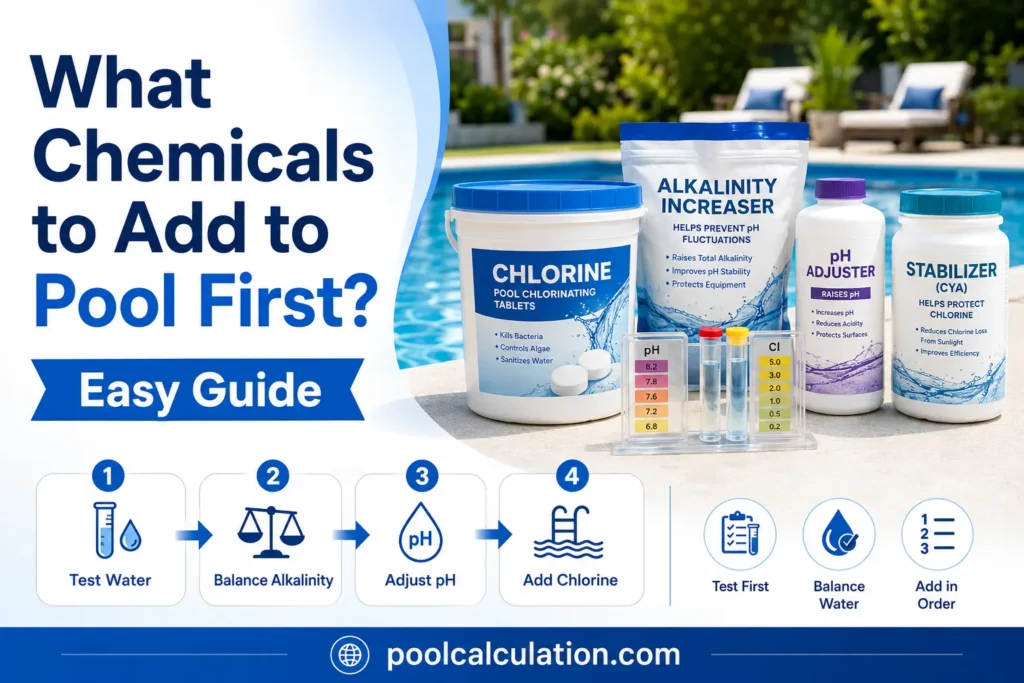
Knowing what chemicals to add to pool first starts with testing the water rather than adding products at random. In most residential pools, a practical sequence is to test everything, adjust total alkalinity if needed, balance pH, review calcium hardness or stabilizer, and then fine-tune chlorine or sanitizer according to the pool’s needs. Always check the product label and allow adequate circulation between major adjustments.
Introduction
If several pool readings are outside their recommended ranges, adding chemicals in the wrong sequence can make balancing harder. Understanding what chemicals to add to pool first gives you a simple starting point and helps prevent unnecessary corrections.
The goal is not to add every chemical at once. Test the water, identify the readings that need attention, make one appropriate adjustment, circulate the water, and retest before moving to the next step. For dosage calculations, you can also use a pool chemical calculator after confirming your pool volume and current test results.
Enter your pool details
Pool Chemical Order of Operations
The pool chemical order of operations is mainly about correcting chemistry that affects other readings first.
1. Test the Pool Water
Before adding anything, test free chlorine, pH, total alkalinity, calcium hardness, and cyanuric acid. Saltwater pools should also be checked for salinity according to the salt system requirements.
Testing gives you a starting point and helps you decide whether an adjustment is necessary. If a result looks unusually high or low, repeat the test before making a large correction.
2. Adjust Total Alkalinity
When deciding what chemicals to add to pool first, alkalinity is commonly addressed before fine pH adjustments. Total alkalinity helps buffer pH, so an unstable alkalinity level can make it difficult to keep pH where you want it.
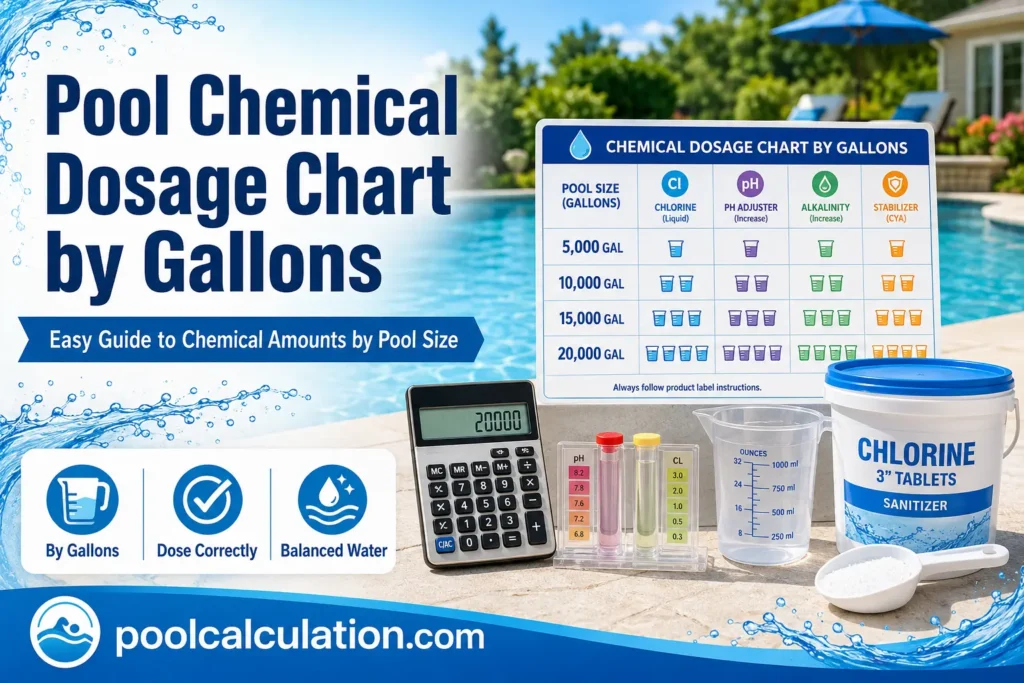
The amount required depends on pool volume, the starting test result, and the product being used. Follow the product label rather than applying a universal dose.
3. Balance pH
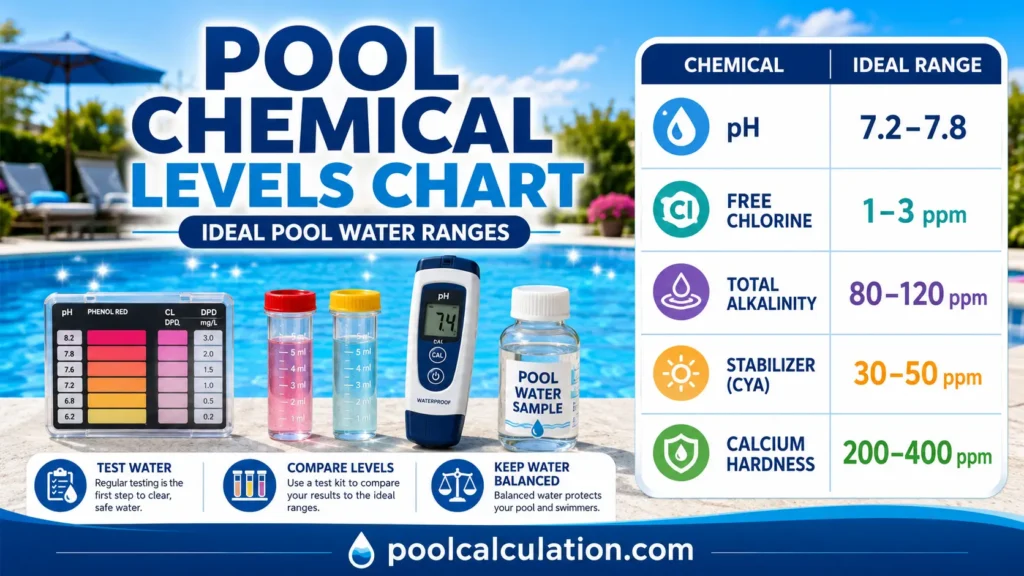
After alkalinity has been addressed, check pH again. A common residential target is around 7.2–7.8, although the appropriate target can vary with the pool and treatment system.
If pH is too high or too low, use the appropriate pH-adjusting product according to its label. Correcting pH is important because it affects swimmer comfort, water balance, and chlorine performance.
4. Check Calcium Hardness and Stabilizer
Calcium hardness and cyanuric acid usually do not require frequent adjustments, but they should be corrected when testing shows they are outside the desired range.
Calcium hardness is particularly important for pools with plaster, concrete, or other cement-based surfaces. Cyanuric acid helps protect outdoor chlorine from sunlight. Test both before adding more because unnecessary additions can create another balancing problem.
5. Adjust Chlorine or Sanitizer
Once the other major balance factors have been reviewed, check the sanitizer level. Free chlorine is commonly maintained around 1–3 ppm in many residential pools, but the correct target depends on the sanitizer system, stabilizer level, and product instructions.
If chlorine is very low, sanitation should be treated as an important priority, and the pool should not be used until the water is properly treated according to product directions and applicable guidance.
What Order to Balance Pool Chemicals?
Balancing is easier when you think in terms of dependency rather than a fixed list for every pool.
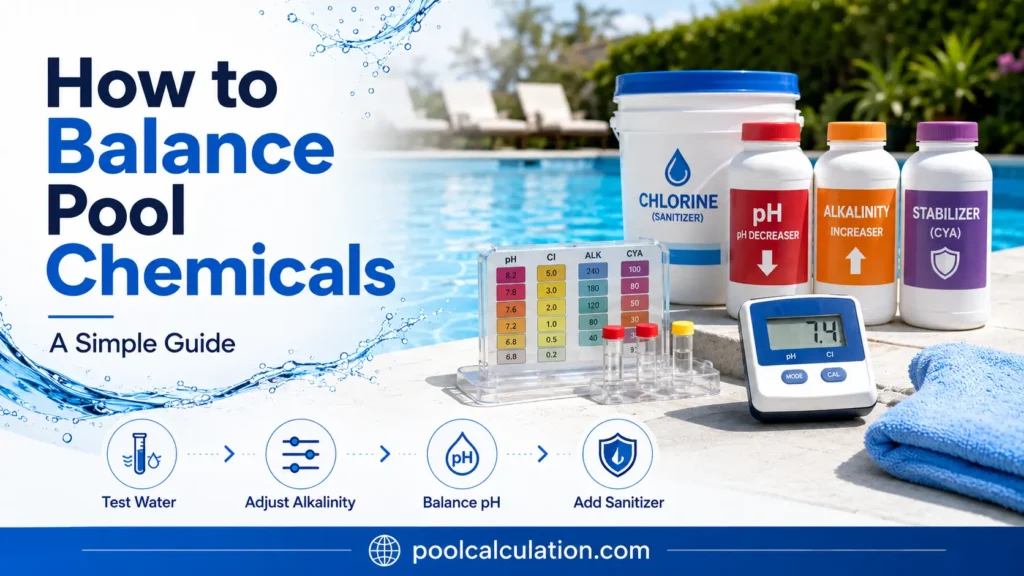
A practical approach is:
- Test the water.
- Correct total alkalinity when needed.
- Recheck and adjust pH.
- Review calcium hardness and cyanuric acid.
- Adjust chlorine or another sanitizer.
- Circulate and retest.
This sequence is a useful general framework, not a substitute for product-specific instructions. Some situations may require a different priority, especially when a sanitizer level is critically low or when a pool professional or equipment manufacturer recommends another sequence.
Should I Adjust pH or Chlorine First?
The answer depends on how far each reading is from its operating range and what type of sanitizer your pool uses.
For routine balancing, correcting significantly abnormal pH before fine-tuning chlorine can make sense because pH affects chlorine effectiveness. However, chlorine is also essential for sanitation. If chlorine is extremely low, address the sanitation issue promptly and keep swimmers out until the water meets the appropriate requirements.
Do not assume that adding more chlorine will fix a pH problem, or that adjusting pH automatically fixes low chlorine. They are separate measurements that need to be tested and corrected appropriately.
Pool Chemical Balancing Order: What to Avoid
Balancing becomes much easier when you avoid common mistakes:
- Adding chemicals without testing first.
- Making several large adjustments at the same time.
- Guessing pool volume.
- Using a dose designed for a different product concentration.
- Adding stabilizer without checking the current cyanuric acid level.
- Retesting immediately instead of allowing the required circulation time.
- Mixing pool chemicals together.
- Ignoring product labels or equipment instructions.
Never mix chlorine products with acids or other incompatible pool chemicals. Store and handle products according to their labels.
How Long Should You Wait Between Chemical Adjustments?
There is no single waiting period for every pool chemical. Required circulation and retesting time depends on the chemical, product instructions, pool size, water temperature, and size of the adjustment.
After making an adjustment, allow the product to circulate as directed and then test again. This helps you see the actual effect before making another correction.
Frequently Asked Questions
Can I add all pool chemicals at once?
It is better not to make multiple major adjustments simultaneously. Test first, follow product instructions, allow circulation, and retest before making another significant correction.
Which pool chemical should I add first?
There is no single chemical that should always be added first. Start by testing the water. If you are unsure what chemicals to add to pool first, start with a complete water test. In routine balancing, total alkalinity is often addressed before pH, followed by other balance factors and sanitizer adjustments as needed.
Does pool size affect the amount of chemical I need?
Yes. Chemical amounts depend partly on water volume, but current test results, target levels, and product concentration also matter. Use the exact product label and an appropriate dosing calculation.
Should I balance pool chemicals before swimming?
Yes. Pool water should be properly tested and treated before swimming. If sanitizer or other water-quality readings are outside appropriate operating ranges, follow product and pool-safety guidance before allowing swimmers into the water.
Conclusion
Knowing what chemicals to add to pool first helps you approach water balancing systematically instead of guessing. Test the water, address alkalinity when necessary, balance pH, review calcium hardness and stabilizer, and then fine-tune chlorine or other sanitizer based on your test results and product instructions. Make adjustments carefully, allow circulation, and retest before adding more. A consistent process makes pool maintenance easier and helps keep water balanced and suitable for swimming.