Quick Answer
A Pool Chemical Dosage Chart helps you scale chemical amounts to your pool volume instead of guessing from a one-size-fits-all dose. Start with an accurate gallon estimate, test the water, identify the exact product and strength, then scale the label dose to your pool size. For example, a 15,000-gallon pool generally uses 1.5 times a dose stated for 10,000 gallons. Product formulas vary, so always confirm the package directions before adding chemicals.
Introduction
This Pool Chemical Dosage Chart gives pool owners a simple gallon-based reference for planning common chemical additions. The amount needed changes with water volume, the current test result, the target level, and the active ingredient or concentration of the product.
Many pool-care dosage guides organize recommendations around common pool sizes such as 5,000, 10,000, 15,000, and 20,000 gallons. This makes it easier to scale a known product dose, but chlorine, shock, pH products, stabilizer, and specialty treatments should not all be treated as if they use one universal dosage.
Pool Chemical Dosage by Gallons
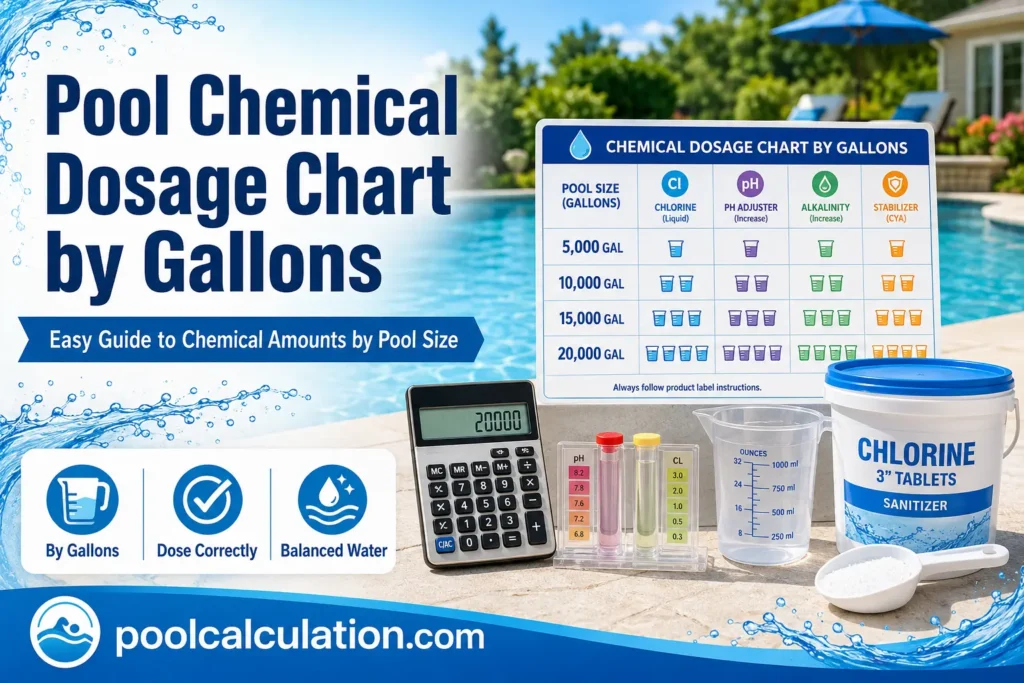
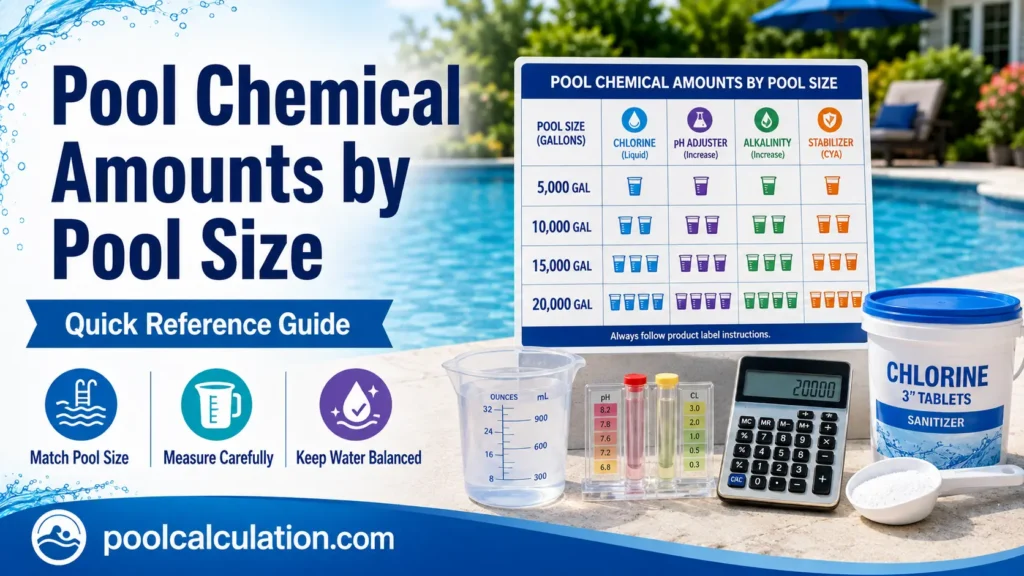
Use the table below to scale a product whose label provides a dose for 10,000 gallons.
| Pool Volume | Scale vs. 10,000 Gal | Example: 1 lb per 10,000 Gal | Salt for +500 ppm |
| 5,000 gallons | 0.5× | 0.5 lb | 20.9 lb |
| 10,000 gallons | 1.0× | 1.0 lb | 41.7 lb |
| 15,000 gallons | 1.5× | 1.5 lb | 62.6 lb |
| 20,000 gallons | 2.0× | 2.0 lb | 83.4 lb |
| 25,000 gallons | 2.5× | 2.5 lb | 104.3 lb |
| 30,000 gallons | 3.0× | 3.0 lb | 125.1 lb |
The third column is a scaling example rather than a universal shock dose. HTH notes that its different shock formulations use different gallon-based doses, which is why the exact product label should remain the final dosing reference.
How to Use the Pool Chemical Dosage Chart
First, calculate your actual pool volume. Then test the water parameter you want to change and check the product label for the recommended starting dose.
Use this simple scaling formula:
Required dose = Label dose × Your pool gallons ÷ Label reference gallons
If a product calls for 1 pound per 10,000 gallons, a 15,000-gallon pool would require 1.5 pounds under the same treatment conditions.
If the label dose is based on a particular ppm increase or starting test range, make sure your water matches those conditions before scaling the amount.
Why Pool Size Changes Chemical Dosage
Pool chemical dosage by pool size matters because larger pools contain more water to treat. When the chemical, starting reading, target, and product concentration stay the same, many gallon-based treatments scale proportionally with water volume.
A pool chemical calculator by gallons can perform the same scaling automatically, but the answer still depends on an accurate pool-volume estimate. If you overestimate pool volume, repeated chemical additions may also be too high.
10,000 and 15,000 Gallon Pool Examples
For pool chemicals for 10000 gallon pool, a product dose stated per 10,000 gallons uses its full 1.0× reference amount. That does not mean every chemical requires the same number of pounds or ounces. The exact quantity still depends on the chemical and product strength.
For pool chemicals for 15000 gallon pool, multiply a 10,000-gallon reference dose by 1.5. For example, a 12-ounce starting dose becomes 18 ounces, while a 2-pound dose becomes 3 pounds.
Common Chemical Dosing Considerations
Chlorine and shock products can vary significantly in concentration and formulation. HTH, for example, lists different gallon coverage for different shock products, while In The Swim provides separate dosage tables based on chlorine type and pool volume.
pH increaser and reducer should not be scaled from gallons alone unless the instructions also account for the current pH range. In The Swim’s dosing tables, for example, change the recommended amount according to both pool volume and starting pH.
Cyanuric acid or stabilizer can be calculated from water volume and the desired ppm increase when the product concentration is known. Test the current level before adding more.
Pool salt is also well suited to gallon-and-ppm calculations. Raising 10,000 gallons by 500 ppm requires approximately 41.7 pounds of pure salt, with the amount scaling proportionally for different pool sizes.
How Much Chemical Should You Add?
If you are trying to determine how much pool chemical to add, pool size is only one part of the answer.
You also need the current water-test result, desired target, chemical type, and product concentration. A dosage table gives the most useful result when these values match the treatment conditions shown on the product label.
For large water-balance corrections, follow the product directions, allow the water to circulate, and retest before automatically repeating the entire dose.
Test Before Adding Chemicals
A Pool Chemical Dosage Chart should be used with fresh water-test results rather than as a replacement for testing.
If a result appears unusual, repeat the test before making a major adjustment. Confirm the pool volume as well, because an incorrect gallon estimate affects every scaled dose.
The CDC specifically includes calculating pool volume and the appropriate chemical amount as part of pool chemical safety practices. It also stresses preventing different pool chemicals from mixing.
Keep chemicals in their original labeled containers and follow the product instructions for measuring, application, protective equipment, circulation, and swimmer re-entry.
Common Mistakes to Avoid
- Guessing the pool volume instead of calculating it.
- Using a 10,000-gallon dose in a larger pool without scaling.
- Treating every chlorine or shock product as the same strength.
- Adding chemicals without fresh water-test results.
- Making several large chemical corrections at once.
- Ignoring the product concentration or active ingredient.
- Mixing different pool chemicals together.
- Repeating the full dose before allowing circulation and retesting.
Frequently Asked Questions
Is a Pool Chemical Dosage Chart exact?
No. It provides a starting reference. Actual dosing depends on pool volume, current water chemistry, target level, chemical type, concentration, and product-specific instructions.
Can I use the same chemical dose for every 10,000-gallon pool?
Not automatically. Two pools with the same volume can have different starting chemistry, and products designed for the same purpose can have different concentrations.
How do I scale a dose from 10,000 to 20,000 gallons?
If the label dose is directly scalable and all other treatment conditions remain the same, multiply the 10,000-gallon amount by two.
How do I scale a 10,000-gallon dose for 15,000 gallons?
Multiply the original amount by 1.5. For example, 8 ounces becomes 12 ounces and 1 pound becomes 1.5 pounds.
Should I add the entire calculated dose at once?
Follow the chemical manufacturer’s label. When correcting water chemistry, staged additions followed by circulation and retesting can help avoid overshooting the intended target.
Conclusion
Use this Pool Chemical Dosage Chart to turn gallon-based product directions into a practical starting amount for your swimming pool. Confirm pool volume, test the water, identify the exact product strength, scale the dose carefully, and follow the product label. Accurate measurements and retesting are more reliable than guessing how much chemical your pool needs.