Quick Answer
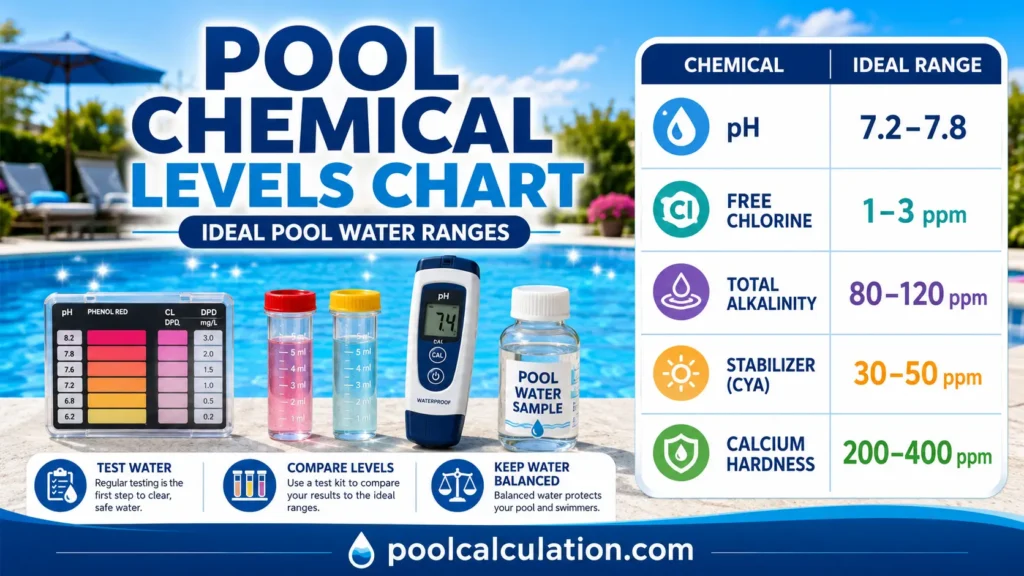
A pool chemical levels chart gives you a quick reference for checking whether your pool water is within commonly recommended ranges. For most residential pools, free chlorine is often kept around 1–3 ppm, pH around 7.2–7.8, total alkalinity around 80–120 ppm, calcium hardness around 200–400 ppm, and cyanuric acid around 30–50 ppm.
Exact targets can vary by pool type, sanitizer system, surface, climate, and equipment instructions.
Introduction
Use this pool chemical levels chart to compare fresh test results with practical target ranges before adding chemicals. Keeping one reading in range is not enough because chlorine, pH, alkalinity, calcium hardness, and stabilizer all affect overall water quality.
The table below is designed as a simple residential reference. Public pools may have different requirements, while saltwater pools should also follow the salt chlorine generator manufacturer’s recommended salinity range.
Recommended Pool Chemical Levels
The following table shows common residential ideal pool chemical levels.
| Pool Parameter | Common Target Range | Why It Matters |
| Free Chlorine | 1–3 ppm | Sanitizes water and helps control algae |
| pH | 7.2–7.8 | Affects swimmer comfort and chlorine performance |
| Total Alkalinity | 80–120 ppm | Helps stabilize pH |
| Calcium Hardness | 200–400 ppm | Helps protect surfaces and manage scale risk |
| Cyanuric Acid (CYA) | 30–50 ppm | Protects chlorine from sunlight |
| Combined Chlorine | As low as possible | High levels may indicate chloramine buildup |
| Salt | Follow system manufacturer | Needed for salt chlorine generator operation |
These values are practical starting targets rather than universal rules. Always consider your pool surface, sanitizer type, water temperature, and equipment recommendations.
How to Read the Chart
Start by testing the water with a reliable test kit or meter. Compare each result with the range shown in the pool chemical levels chart and identify which values need attention.
Do not adjust every number at the same time. If several readings are outside their target ranges, prioritize sanitizer and pH problems first, then review alkalinity, stabilizer, calcium hardness, and salt as needed.
A pool chemistry levels chart is most useful when combined with accurate testing rather than used as a replacement for it.
Chlorine, pH, and Alkalinity
Chlorine, pH, and total alkalinity are closely connected.
Free chlorine is the main sanitizer in most residential chlorine pools. pH affects how comfortable the water feels and how effectively chlorine works. Total alkalinity helps buffer pH so it does not move too quickly.
A pool chlorine ph alkalinity chart can make these relationships easier to understand, but each reading should still be tested individually.
If chlorine is low, sanitation may become less effective. If pH is too high, chlorine performance can decline and scale may become more likely. If alkalinity is too low, pH can become unstable.
Calcium Hardness and Stabilizer
Calcium hardness matters especially in plaster, concrete, and other cement-based pool surfaces. Water with very low calcium hardness can become aggressive, while high calcium combined with high pH can increase scaling risk.
Cyanuric acid, or stabilizer, helps protect chlorine from sunlight in outdoor pools. Low stabilizer can allow chlorine to disappear quickly, while excessive stabilizer can make chlorine management more difficult.
Because cyanuric acid is not quickly removed from pool water, test the current level before adding more.
Understanding Pool Water Balance
A pool water balance chart gives a useful snapshot, but balanced water depends on how several values interact.
pH, alkalinity, calcium hardness, water temperature, and dissolved solids can influence whether water tends toward corrosion or scale formation. This is why two pools with the same pH can still behave differently.
For more precise balancing, pool owners may also use a saturation-index calculation alongside routine chemical testing.
What to Do When a Level Is Too Low or Too High
Before adding a chemical, repeat any test result that looks unusual. Then confirm the pool volume and check the active ingredient and concentration of the product you plan to use.
Different pool chemical ranges require different corrections. Chlorine can be raised with an appropriate sanitizer, alkalinity is commonly raised with sodium bicarbonate, and stabilizer is usually increased with cyanuric acid. pH may require an acid or base depending on the direction of adjustment.
Use the pool chemical levels chart again after retesting to confirm whether the corrected value has moved into the desired range. Large changes should be made carefully, with enough circulation time before another adjustment.
Never mix pool chemicals together, especially chlorine products and acids.
How Often Should Pool Chemical Levels Be Tested?
Chlorine and pH should be checked frequently because they can change with sunlight, swimmers, rain, temperature, and chemical additions.
Alkalinity, calcium hardness, stabilizer, and salt usually change more slowly, but they should still be checked regularly and after major events such as heavy rain, draining, refilling, or significant chemical treatment.
This reference is especially useful after these changes because it helps you compare multiple readings in one place before deciding what to adjust.
Common Mistakes to Avoid
- Adding chemicals without testing first.
- Guessing the pool volume.
- Treating every pool type as if it has identical target ranges.
- Adding stabilizer without checking the current CYA level.
- Ignoring the relationship between pH and alkalinity.
- Making several large corrections at once.
- Retesting too soon after a chemical addition.
- Ignoring equipment or surface-specific recommendations.
- Mixing chlorine and acid.
Frequently Asked Questions
What are the most important pool chemical levels?
For most residential pools, the key readings are free chlorine, pH, total alkalinity, calcium hardness, and cyanuric acid. Saltwater pools should also monitor salinity.
What should chlorine and pH be in a pool?
A common residential target is about 1–3 ppm free chlorine and pH between 7.2 and 7.8. Your exact sanitizer target may depend on stabilizer level and the pool-care method being used.
What happens if pool alkalinity is too low?
Low alkalinity can make pH change more quickly and may contribute to aggressive water conditions.
Is high calcium hardness bad for a pool?
High calcium hardness can contribute to scale, especially when pH and overall water balance also favor scaling.
Can I use this pool chemical levels chart for a saltwater pool?
Yes, as a general reference. Saltwater pools still need chlorine, pH, alkalinity, calcium hardness, and stabilizer management, but salinity should be kept within the range specified by the salt system manufacturer.
Conclusion
Use this Pool Chemical Levels Chart as a quick reference when reviewing fresh water-test results. Keep chlorine, pH, alkalinity, calcium hardness, stabilizer, and salt within suitable ranges for your pool, make large corrections gradually, and always follow product and equipment instructions before adding chemicals.